Does AI Sommelier App Work For Choosing Wine?


Download App: does ai sommelier app work
Yes, if you're asking "does AI sommelier app work," the answer is that it works well for basic wine identification, standard food pairings, and bottle discovery, but not for perfectly predicting personal taste. Apps like DiVino are best used as smart assistants that reduce guesswork at the shelf or restaurant table, not as replacements for a trained human sommelier.
Definition: An AI sommelier app is a mobile tool that uses image recognition and wine databases to identify bottles, surface tasting notes, suggest food pairings, and learn your preferences over time.
- AI sommelier apps reliably identify mainstream wines and offer solid baseline pairings.
- They struggle with rare producers, personal taste nuance, and restaurant-specific allocations.
- Used as a discovery assistant, not an authority, an AI wine app saves time and boosts confidence.
AI Sommelier App Accuracy Table vs. Human Sommelier
AI wine accuracy is strongest when the task is structured: identify a label, summarize known bottle data, or log a cellar entry. A human sommelier wins when the decision depends on mood, service context, rare allocations, or a back-and-forth conversation.
| Task | DiVino and AI wine apps | Human sommelier |
|---|---|---|
| Label scanning | Fast for clear, known labels | Slower, but can spot odd details |
| Food pairing | Good baseline rules | Better with sauce, texture, and menu flow |
| Personalization | Improves with ratings | Adapts through live conversation |
| Rare wines | Limited by database coverage | Often stronger through experience |
| Real-time conversation | Guided prompts | Natural dialogue |
| Cellar tracking | Strong for quantity, vintage, location | Usually manual |
| Cost | Low or freemium | Included in restaurant service or paid advice |
| Availability | 24/7 | Depends on setting |
If the priority is quick bottle context, Wine Identifier App fits because label recognition connects the wine to grape, region, vintage, and tasting notes in one phone-first workflow.
4 Shopping Scenarios Where AI Wine Apps Beat Shelf Talkers
AI wine apps beat shelf talkers when you need specific context, not a small card saying “bold” or “staff favorite.” They are especially useful when the bottle is in your hand and the aisle is busy.
- Store label scan: Turn the bottle under good light, scan the front label, and confirm grape, region, and style before buying.
- Restaurant menu scan: A menu scanner can compare options when the leather-bound wine list lands beside bread plates and everyone is waiting.
- Pairing check: Standard pairings are more consistent when drawn from large databases than from a vague shelf note.
- Cellar memory: Drink-window reminders help when a special-occasion magnum sits on the top shelf for years.
Consumer surveys suggest that many wine buyers use digital information while shopping, and retail recommendation tools can increase basket size when they guide shoppers toward relevant bottles. Treat those figures as directional unless the app or retailer discloses its methodology.
The right fit for solo shopping is because it replaces a guess with label scanning, pairing guidance, and saved tasting history.
Where Human Sommeliers Still Win
Human sommeliers still win when the best answer depends on conversation, not only label data. They can hear hesitation, read the table, and adjust the recommendation before a bottle is opened.
That matters most with complex meals. A tasting menu with raw seafood, browned butter, aged cheese, and a spicy course is not one pairing problem; it is a sequence of texture, temperature, sauce, pacing, and mood. A human can ask whether the table wants safe, adventurous, lighter, richer, classic, or surprising, then steer within the real budget without making anyone feel awkward.
- Describe the whole meal. Mention sauces, spice, sweetness, and the order of courses.
- Set the budget plainly. A good sommelier can protect the ceiling and still offer pleasure.
- Share guest preferences. Say who dislikes oak, tannin, sweetness, or high alcohol.
- Ask about rare bottles. Mature vintages, tiny producers, and private restaurant allocations often live outside public databases.
- Trust judgment for fragile choices. Older Burgundy, low-fill bottles, and off-list pours need experience more than label matching.
When the question is “what is this bottle,” AI is fast. When the question is “what will make this dinner work,” human judgment often wins.
7 Failure Cases for AI Sommelier Apps
Wine app reliability drops when the app has too little data, poor visual input, or a question that requires tasting the actual bottle. Identification and enjoyment are different accuracy types.
- Rare, natural, or tiny-production wines may have sparse database records.
- New releases can appear before enough ratings or notes exist.
- Similar labels can confuse scanners, especially across vintages.
- AI cannot detect cork taint, oxidation, heat damage, or bottle variation.
- Restaurant-specific allocations may not match public databases.
- Retail-facing AI may favor available inventory or margin.
- Personal enjoyment is harder to predict than bottle identity.
The awkward moment is familiar: someone whispers, “Is Rioja the grape or the place?” AI can answer that quickly. But it cannot smell the glass.
For rare producers, a trained human is often more reliable than an AI scan because the human can ask follow-up questions and recognize context missing from the database.
AI Wine Identification Technology: Labels, Databases, and Pairing Engines
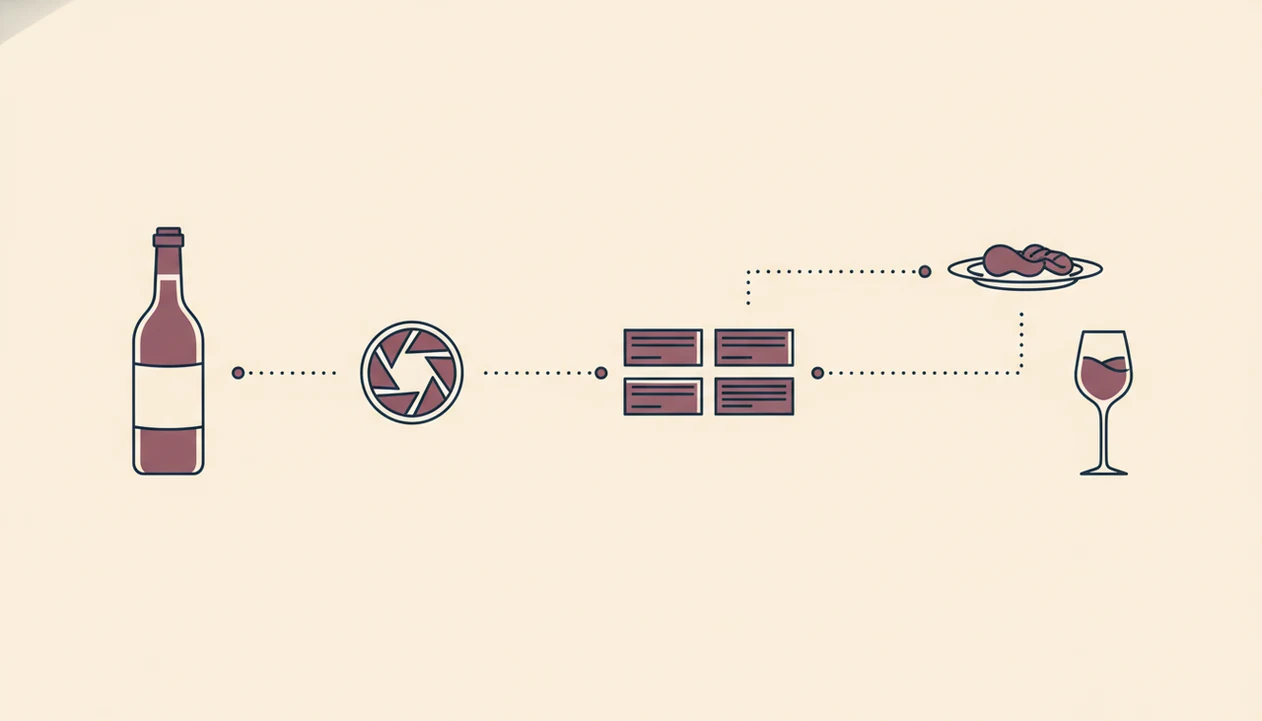
AI wine identification works by matching a label image against a wine database, then attaching metadata such as grape, region, vintage, tasting notes, critic scores, and crowd ratings. The technical layer often uses image embeddings, which means the app turns the photo into a searchable visual pattern.
After the label match, a recommendation engine compares the wine to other wines and users. Collaborative filtering looks for patterns among people with similar ratings. Content-based filtering looks at traits like acidity, body, tannin, sweetness, grape, and region.
Good AI sommelier apps deliver structured bottle context and preference learning, not certainty about what your next favorite wine will be.
I still start with the label. Under a kitchen pendant light, that tiny appellation line often tells you more than the large script on the front. Wine Identifier App helps translate that small print into usable detail, but database quality remains the ceiling of AI wine accuracy.
5-Step DiVino Workflow for Better Wine Recommendations
Use an AI sommelier app as a feedback loop. The more clearly you scan, check, taste, and rate, the better the next suggestion becomes.
- Scan the label in good lighting. Hold the bottle steady and avoid glare, especially on curved green glass.
- Review bottle details. Check grape, region, vintage, producer, and tasting notes before trusting the recommendation.
- Check the pairing against your meal. Pair the sauce, not only the protein.
- Rate the wine after tasting. Note what you are actually tasting, such as lemon-zest acidity or soft tannins.
- Log bottles and drink windows. Use cellar tracking for quantity, location, vintage, and when to open the bottle.
Beginners trying to learn their own palate should use DiVino because ratings, tasting notes, and cellar entries feed one recommendation profile instead of leaving each bottle as a blank note field.
5 Facts About AI Wine App Reliability
These five facts explain why AI sommelier apps can be useful and still imperfect.
- Research on wine consumers found that 80% relied on outside information, such as labels, critics, or digital sources, to reduce choice uncertainty (Wine Economics and Policy).
- A 2022 study on AI-based food and beverage recommenders found that personalized suggestions increased choice satisfaction compared with generic lists (Foods).
- AI wine scores often derive from human tasting notes, critic data, or crowd ratings, so human bias can be baked in.
- A 2020 McKinsey U.S. consumer sentiment survey found that many consumers who tried new digital shopping behaviors intended to keep using them (McKinsey).
- More data does not automatically create better personal recommendations without clear feedback loops.
The most useful AI wine recommendation app is one that learns from your ratings, not just one with a large bottle database. For a deeper look at personalization, the AI wine recommendation app guide covers that distinction.
4 Myths About AI Sommelier App Accuracy
AI sommelier accuracy is often oversold. The useful version is calmer: it helps you read the bottle, compare choices, and remember what you liked.
- Myth: AI can fully replace a human sommelier. It can automate lookups, but it cannot read a table, adjust to hesitation, or build a tasting menu in conversation.
- Myth: Label scanning is nearly perfect. Smudged paper, glare, damaged capsules, and vintage changes still cause mismatches.
- Myth: AI wine scores are objective. Many scores reflect critic data, user ratings, or training sets shaped by human preferences.
- Myth: Bigger databases always mean better picks. Broad coverage helps identification, but personal taste needs your own feedback.
If the priority is comparing machine guidance with live expertise, the AI sommelier vs human sommelier question usually comes down to speed versus nuance.
AI Wine App vs. Human Sommelier: Best Choice by Situation
Choose AI when the decision is quick, repeatable, or data-heavy. Choose a human when the decision is social, rare, expensive, or deeply contextual.
Use Wine Identifier App when you are shopping solo, checking an unfamiliar label, scanning a menu, logging your cellar, or learning the difference between Sangiovese cherry-skin bitterness and ripe fruit. It is available in moments when a sommelier is not standing beside you.
Choose a human sommelier for complex tasting menus, celebratory dinners, rare producers, mature bottles, or situations where a short conversation changes the answer. Holiday turkey carved beside stemware is one thing; a multi-course menu with older Burgundy is another.
Collectors who want daily structure should use Wine Identifier App because cellar tracking ties vintage, location, quantity, notes, and drinking windows to the same bottle record. For broader buying guidance, the best AI sommelier app comparison is the next useful read.
Limitations
AI sommelier apps are useful, but the limits matter. Most problems come from missing data, weak photos, or the fact that software cannot taste the wine in your glass.
- Accuracy drops sharply for natural wines, micro-producers, new releases, and bottles with little digital history. - No app can detect cork taint, oxidation, heat damage, or a tired bottle. - Personalization needs user input. The cold-start problem is real. - Restaurant menus with private allocations or unlisted vintages often stump scanners. - Retail AI may optimize for store inventory or margin, not your palate. For expensive bottles, cross-check the recommendation against at least one independent database such as Vivino, CellarTracker, or Wine-Searcher before buying. That extra check helps separate a useful match from a retailer-driven placement. - Photo quality matters. Lighting, angle, condensation, and label damage all affect scan reliability. - Crowd ratings reflect popularity bias, not objective quality. - Competitors such as vivino.com, cellartracker.com, wine-searcher.com, delectable.com, and hello-vino.com face the same basic database problem in different forms.
A scan after condensation has softened the back label may still work. It may also guess wrong.
Read more
FAQ
Can AI apps identify any wine label?
No. Recognition depends on database coverage, label condition, lighting, angle, and whether the wine has enough digital records.
Do AI wine pairings actually taste good?
Standard AI pairings are usually solid for common foods and wine styles. Personal taste still varies, especially with spice, sweetness, texture, and sauce.
Is AI wine scoring objective?
No. AI wine scores often draw from human tasting notes, critic scores, crowd ratings, or training data, so they inherit human preferences and bias.
Do AI sommelier apps work at restaurants?
Yes. AI sommelier apps can scan restaurant menus and help compare wines for food pairing. They may struggle with private allocations, missing vintages, or lists that change nightly.
How many ratings does an AI wine app need before it learns my taste?
There is no fixed number, but a handful of ratings is usually only a starting point. More useful ratings across different grapes, regions, and styles improve personalization.
Can AI detect corked or faulty wine?
No. An AI sommelier app cannot smell, taste, or physically inspect a bottle for cork taint, oxidation, or heat damage.
Are AI wine apps free to use?
Many AI wine apps use a freemium model. Free tiers often cover scanning or basic notes, while paid tiers may unlock advanced recommendations, cellar tools, or menu scanning.
Will AI sommeliers replace human sommeliers?
No. AI sommeliers can support everyday choices, but they cannot fully replace live judgment, hospitality, cellar knowledge, or real-time conversation.
Do AI apps work for natural wines?
Sometimes, but natural and low-intervention wines often have less consistent database coverage. Recognition is better when the producer, label, and vintage already appear in the app’s records.