Can AI Wine Recommendations Be Wrong? Errors, Limits, and Uncertainty Explained


Download App: can ai wine recommendations be wrong
If you're asking "can AI wine recommendations be wrong," the answer is yes: algorithms infer taste from indirect signals like labels, crowd ratings, and text reviews rather than actually tasting wine. Errors in label recognition, vintage confusion, biased training data, and missing context about your palate or meal can all produce mismatched suggestions. Responsible wine apps should treat AI picks as informed starting points and disclose uncertainty rather than presenting every suggestion as an expert verdict.
Definition: AI wine recommendation errors are inaccurate or misleading bottle suggestions caused by data gaps, label-scan mistakes, biased crowd ratings, or the fundamental inability of algorithms to replicate human sensory experience.
TL;DR
- AI cannot taste or smell wine, it pattern-matches from text, images, and ratings, leaving a permanent gap between prediction and reality.
- Label-scan errors, vintage confusion, and biased community ratings cascade into wrong food pairings and misleading quality expectations.
- Over 60% of AI consumer tools studied provide little or no transparency about how recommendations are generated.
- Users overweight AI suggestions framed as “expert” by 10–20 percentage points, even when those suggestions contain errors.
- Responsible wine apps should show confidence levels, explain recommendation logic, and encourage personal validation.
At a Glance: Why AI Wine Recommendations Can Be Wrong
AI wine mistakes usually come from five sources: incomplete data, scan errors, no sensory input, rating bias, and missing context. A recommendation can sound precise and still miss what you are actually tasting.
- Data gaps: A small Jura producer with 18 public ratings gives the model less to learn from than a supermarket Cabernet with thousands.
- Label errors: A camera can confuse two cuvées from the same estate, especially when the vintage line is tiny or smudged.
- No sensory ability: AI cannot smell volatile acidity, feel chalky Nebbiolo tannin on the gums, or notice a tired bottle.
- Crowd-rating bias: Popular styles often rise faster, and recommender research has found 40–50% reduced exposure for less popular items compared with neutral baselines. Source the exposure claim with an inline URL to the recommender-systems study being referenced, or remove the 40–50% figure if no source can be provided.
- Context blindness: “Pairs with steak” changes when the sauce is peppercorn, chimichurri, or sweet barbecue glaze.
Start with the label, then verify the details.
Scope and Safety Notes for AI Wine Recommendations
AI wine recommendations are consumer guidance for choosing, pairing, or comparing bottles; they are not medical, legal, or safety advice. If alcohol creates any health, legal, or dependency risk for you, treat the app’s output as secondary to professional judgment.
Use a simple safety check before acting on a suggestion:
- Separate taste advice from health advice. A model can predict that a Riesling may fit spicy food, but it cannot decide whether alcohol is appropriate for your body, age, condition, or circumstances.
- Ask a qualified clinician about alcohol-related health questions, especially if you have allergies, suspected sulfite or ingredient reactions, or a history of dependency concerns.
- Check medication labels and medical guidance for alcohol interactions before drinking, even when the recommendation itself looks harmless.
- Avoid relying on wine-app guidance during pregnancy or when trying to become pregnant; get advice from a qualified medical professional.
- Inspect the actual bottle before serving. App outputs cannot verify storage history, heat damage, spoilage, cork taint, or whether a wine is safe to consume.
When risk exists, use personal judgment first and professional advice where needed.
How AI Wine Recommendation Engines Work
AI wine recommendation engines work by combining label recognition, wine metadata, tasting language, ratings, and user behavior to predict likely matches. The prediction is useful, but it is still an inference from stored signals, not a sensory judgment.
Label Scanning and Image Recognition Pipeline
A scan usually starts with OCR and image recognition. The app reads producer names, appellations, vintage years, and sometimes importer text. I have turned a bottle around under a kitchen pendant light just to find the tiny appellation line, and that is exactly the kind of detail a camera may miss. Retailer catalogs, expert notes, and structured wine databases then help identify the bottle.
Collaborative Filtering and Crowd-Rating Signals
Collaborative filtering says, “People who liked these bottles also liked that one.” Content-based filtering says, “This bottle resembles wines you rated well because it shares grape, region, acidity, tannin, or flavor descriptors.” Tools like Wine Identifier App scan labels and menus, then match them against a structured wine database. Still, studies of AI consumer decision tools report that over 60% provide little or no transparency about how recommendations are generated.
Common Myths About AI Wine Recommendation Accuracy
AI wine tools can be helpful, but several myths make people trust them too much. The main problem is not that algorithms are useless; it is that they can sound more certain than the data allows.
Myth: AI Always Beats a Human Sommelier
AI can compare thousands of bottles quickly. A sommelier can read the table, notice the food, and ask whether you dislike oak.
Myth: High Ratings Mean You Will Love It
A 4.3 crowd score may reward ripe fruit, heavy oak, or sweetness. If you prefer bright acidity and leaner texture, that score may point you away from pleasure.
Myth: Label Scans Are Error-Free
Wax, glare, curved glass, and similar branding all matter. A tiny vintage year above the barcode can change the whole recommendation.
Myth: A Few Ratings Teach AI Your Palate
Five ratings are a sketch, not a portrait. Advice-taking studies also show that people may overweight algorithmic suggestions when systems are framed as expert.
Five Data Gaps That Cause AI Wine Mistakes
The most common AI wine mistakes begin before the recommendation appears. If the database is thin, noisy, or too popularity-driven, the output inherits those weaknesses.
Sparse Ratings and Niche Producer Blind Spots
Small producers: A tiny-production Etna Rosso may have too few ratings to form a stable pattern.
Natural wines: Low-intervention bottles often vary more by batch, storage, and serving condition, so consensus notes can be thin.
Non-mainstream regions: Wines from places outside the app’s rating core may be less visible, even when they are excellent for the right drinker.
Vintage Confusion and Label Similarity
Vintage variation: A cool-year Riesling and a warm-year Riesling from the same producer can taste quite different.
Look-alike labels: Same estate, different cuvée. One line of text can separate a simple village wine from a structured reserve.
Missing food context: Season, cuisine, sauce, and occasion rarely fit cleanly into a rating table.
Popularity bias can also push familiar bottles forward. In recommender research, less popular items saw 40–50% lower exposure than a popularity-neutral baseline.
How Label-Scan Errors Cascade Into Wrong Wine Pairings
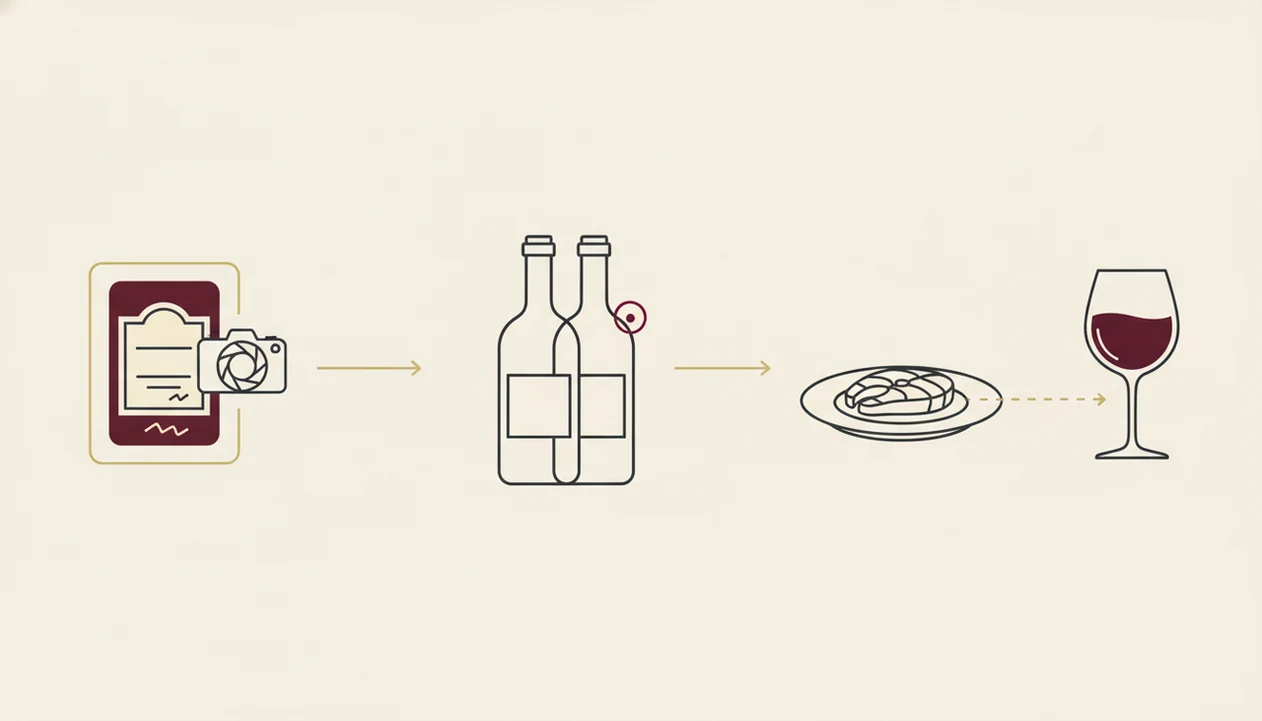
A label-scan error can turn one small mistake into the wrong bottle profile, pairing, price expectation, and serving advice. The first error is often boring: the camera reads the wrong vintage or selects a similarly branded wine.
Picture a wax-sealed bottle on a marble counter. The scan catches the producer but misses the cuvée. Now the app thinks an $80 structured red is a $15 easy-drinking bottling, or the reverse. Pairing advice follows the wrong data, so a delicate mushroom dish gets matched with tannin and alcohol it never asked for.
Pair the sauce, not only the protein.
Wine Identifier App mitigates this by showing confidence indicators and allowing manual correction when the label match looks off. For a broader scan-quality breakdown, the question are wine scanner apps accurate is worth separating from recommendation accuracy.
Responsible Uncertainty Disclosure in AI Wine Tools
Responsible uncertainty disclosure means an AI wine tool tells users how confident it is, why it made a suggestion, and when the data is weak. Without that context, a recommendation can feel like a verdict when it is only a probability.
Confidence Scores and Match Explanations
A good interface should show match confidence, not just a bottle name. It should also explain the logic: “recommended because you rated high-acid Sangiovese well,” or “matched to grilled lamb because of tannin and savory notes.” That explanation gives the user something to test.
When a Wine App Should Flag Uncertainty
A responsible wine app can offer label scans, menu scans, bottle details, pairing ideas, and cellar tracking, but it still cannot guarantee taste certainty. That distinction matters because over 60% of AI decision tools studied offered limited transparency, and people often overweight AI advice framed as expert by 10–20 percentage points.
For most drinkers, a visible confidence score is easier to use than a hidden algorithm because it shows when to trust, check, or ignore the suggestion.
Evidence Behind These AI Wine Recommendation Limits
The evidence for these limits is mixed: some comes from wine-app behavior, but much of it comes from broader recommender-system and human-computer-interaction research. That means the pattern is useful, while exact numbers should be treated as directional unless the study is wine-specific.
Wine-specific evidence is strongest for obvious failure points: label scans can confuse vintages, producers, and look-alike cuvées; crowd tasting notes can miss bottle condition, serving temperature, and personal palate. Broader recommendation research explains why those errors matter. Studies of popularity bias show that recommender systems can amplify already-visible items and reduce exposure for niche choices source. Research on algorithmic advice-taking and automation bias also shows that people may lean too heavily on machine suggestions, especially when the interface sounds confident or expert source.
A practical evidence check is simple:
- Separate wine-specific claims from general AI claims.
- Treat exposure and overtrust figures as indirect unless tested in wine apps.
- Look for explanations, confidence scores, and correction tools.
- Validate the bottle with your own label check, food context, and tasting notes.
Recommendation Transparency Controls to Look For
A trustworthy wine recommendation tool should treat recommendations as guided estimates, not sommelier-certified ratings. Every recommendation includes a match-confidence indicator, so a user can tell whether the system has strong evidence or is working from thin data.
When a scan misidentifies a label, users can report the mistake. The same applies to incorrect pairings, wrong vintages, and mismatched bottle details. Those corrections help improve future results, especially around look-alike labels and lower-data wines.
There is still judgment involved. If you scan a steakhouse list opened to reds and the app suggests a high-tannin bottle, you still need to ask what sauce, sides, and table preferences are in play. AI can organize clues quickly. It cannot replace the last human check.
What AI Wine Recommendation Limits Do NOT Cover
AI wine recommendation limits do not cover everything that can go wrong after a bottle is suggested. Some problems happen outside the data, the model, and the app.
A recommendation cannot know whether a bottle sat in a hot delivery truck, under bright retail lights, or in a warm apartment closet. It also cannot detect cork taint after purchase. That damp-cardboard smell appears only when the bottle is opened.
Health reactions are outside wine recommendation logic. Allergies, medication interactions, sulfite sensitivity concerns, and personal medical advice should be handled with a clinician, not an app. Clinicians typically recommend discussing alcohol-related health questions with a qualified medical professional rather than relying on consumer recommendation tools.
Restaurant stock and pricing are also fluid. A menu scan may read a bottle correctly, but it cannot guarantee availability, markup, or whether the last bottle just left the cellar.
Limitations
AI wine recommendations have hard limits that better design can reduce but not remove. The permanent issue is simple: the system cannot taste or smell the wine.
- No sensory input: AI infers lemon-zest acidity or cherry-skin bitterness from text and metadata, not from a glass.
- Rare wines degrade accuracy: Tiny producers, natural wines, and low-data regions produce thinner recommendation signals.
- Preference drift matters: Your palate may move from ripe fruit to bright acidity before the model catches up.
- Popularity bias is structural: Recommender research has shown 40–50% reduced exposure for less popular items, which can hide niche bottles.
- Overreliance narrows discovery: If every choice comes from a score, you may miss the odd bottle that teaches you something.
- Crowd ratings are not your palate: Aggregate approval does not explain whether you like oak, tannin, sweetness, or oxidation.
- Vintage remains difficult: No current system fully accounts for year-to-year variation within the same wine.
A tasting wheel beside a notepad still has value. Your own notes are data too.
If photo handling concerns are part of your decision, the separate wine app privacy guide explains what to check before uploading labels.
Read more
FAQ
Can AI actually taste wine?
No. AI infers flavor from label images, tasting notes, ratings, and metadata, but it has no ability to smell, taste, or feel texture.
Why did AI recommend a wine I hated?
The app may have relied on sparse data, biased crowd ratings, or incomplete information about your palate. Wine preference is subjective, and one high-scoring bottle can still clash with your taste.
Are AI wine picks better than sommeliers?
AI is faster at scanning large catalogs and comparing stored data. Sommeliers are better at reading context, asking follow-up questions, and responding to the actual table.
Should a wine app show recommendation confidence?
Yes. A responsible wine app should show confidence signals and flag uncertainty when a bottle, pairing, or data match is less reliable.
Can label scans misidentify a wine?
Yes. OCR and image recognition can confuse similar labels, miss tiny vintage text, or struggle with rare producers and damaged labels.
How many ratings before AI knows my taste?
There is no fixed number. Early recommendations face a cold-start problem, and models need ongoing ratings because preferences change over time.
Do AI wine apps work for natural wines?
They can help, but accuracy is often weaker for natural and low-intervention wines because public data, expert consensus, and bottle consistency may be limited.
Can AI match wine to my specific meal?
AI can suggest pairings from grape, acidity, tannin, sweetness, and food keywords. It may miss cuisine nuance, season, sauce, cooking method, and the mood of the meal.
How do I report a wrong recommendation?
In Wine Identifier App, use the feedback or report option on the bottle or pairing result to flag a misidentified label, incorrect vintage, or poor match. User corrections help improve future recommendations.