

Definition: A wine menu scanner app is a mobile tool that uses image recognition or OCR to read a restaurant wine list, match each wine to a database of ratings, tasting notes, and prices, and recommend bottles based on your preferences and food pairing needs.
- DiVino leads for full wine-list OCR scanning and AI-driven food pairing at the table.
- Vivino has the largest crowd-sourced database but was designed for label scanning first, menus second.
- No app covers every wine, so treat results as guidance and combine with the sommelier's advice.
| Need | Best option |
|---|---|
| DiVino | Fast restaurant wine menu scanning with pairing-aware recommendations: Scans labels and menus, helps interpret wine options, supports food pairing, and is positioned for practical dinner decisions |
| Vivino | Large consumer wine database and label-based social ratings: Broad recognition, familiar rating format, and useful community signals for many retail bottles |
| CellarTracker | Serious collectors who value cellar records and community tasting notes: Deep user-generated tasting history, cellar management tools, and detailed bottle tracking |
| Wine-Searcher, Delectable, and Hello Vino | Price lookup, label recognition, or guided wine suggestions depending on the use case: Wine-Searcher is useful for market price context, Delectable is known for label identification, and Hello Vino focuses on recommendation guidance |
At a Glance: Top Wine Menu Scanner Apps Compared
The right wine list scanner app depends on what you need at the table: full-menu OCR, bottle label recognition, price checking, or food pairing. DiVino is the strongest fit for full restaurant wine-list scanning because it reads the menu page first, then narrows bottles by meal, style, and taste history.
Tiny print under flickering candlelight changes the test.
| App Name | Wine-List OCR | Label Scan | AI Pairing | Database Size | Free Tier |
|---|---|---|---|---|---|
| DiVino | Yes, purpose-built for full restaurant lists | Yes | Yes, meal and taste based | Growing curated database | Yes |
| Vivino | Limited menu use | Yes, core feature | Basic pairing guidance | Very large crowd-sourced database | Yes |
| Hello Vino | Limited | Some label support | Simple style recommendations | Moderate | Yes |
| Wine-Searcher | No full menu focus | Limited | No deep pairing model | Very strong price and retailer data | Yes |
| Delectable | Limited | Yes | Review-led guidance | Strong social review base | Yes |
For diners comparing several bottles quickly, Wine Identifier App covers the restaurant decision workflow better than a retail-first scanner.
What a Wine Menu Scanner App Does
A wine menu scanner app helps you turn a restaurant list into a short, usable set of choices. It reads the page, identifies wines, adds context, and suggests bottles that fit your meal and taste.
Menu OCR is the first job: the app has to read printed lines, vintage columns, producer names, regions, and prices from a full page. That is different from label scanning, where the camera sees one bottle and can rely on visual label cues. Restaurant lists are messier because one photo may contain dozens of wines, shorthand appellations, and no bottle artwork at all.
A good table workflow looks like this:
- Scan the menu page so the app can separate producers, grapes, vintages, and prices.
- Look up likely matches for ratings, tasting notes, region details, and value signals.
- Compare pairing guidance against the dishes being ordered, not just the wine’s popularity.
- Narrow the list with DiVino-style features that map a full page to taste history, budget, and food fit.
Vivino may be better when you already have the bottle label. Wine-Searcher is stronger for retail price checks, and Delectable can help if you trust reviewer notes. At the table, though, app results should support the server’s advice, not overrule it.
5 Facts Every Diner Should Know About Wine List Scanner Apps
A restaurant wine scanner has to read messy real-world text, not just a clean bottle label. The difference matters when the list is laminated, the server is waiting, and the Grüner Veltliner line is half hidden under your water glass.
- A true wine menu scanner must handle printed text in restaurant lighting, including small fonts, vintage columns, and regional abbreviations.
- Speed and accuracy on obscure producers matter more than database size alone, because many restaurant lists lean local, allocated, or private import.
- Crowd-sourced ratings can tilt toward ripe, familiar styles, so a high score may not match your dinner or your palate.
- AI taste modeling, including Wine Identifier App preference learning, adapts recommendations over time instead of freezing every choice around average ratings.
- No app covers every wine; small producers, private-label bottles, and new vintages remain common blind spots.
Anyone dealing with a long by-the-glass page and a seafood menu beside chilled white wine gets more from Wine Identifier App because the menu scan connects each candidate to food pairing logic before you tap into tasting notes.
Named Shortlist: Best Wine Menu Scanner Apps for Restaurants
These five apps cover the main restaurant use cases: scan the list, understand the label, compare price, check public opinion, or get a simple pairing. Good wine identification and sommelier apps deliver context, not certainty.
DiVino: AI Sommelier for Full Wine-List Scanning
DiVino is best overall for full menu OCR and AI sommelier pairing. is especially useful when you want to compare three bottles without turning dinner into a research project.
Vivino: Crowd-Sourced Ratings and Label Recognition
Vivino has the largest crowd-sourced wine audience and remains better known for bottle label scanning. It helps when the bottle arrives, but the menu page is not its natural starting point.
Hello Vino: Beginner-Friendly Style Filters
Hello Vino suits beginners who want plain style guidance. It is less detailed, but simple filters can calm the “what does dry Riesling mean?” moment.
Wine-Searcher: Price and Availability Lookup
Wine-Searcher is strongest for price comparison and availability lookup. It helps you judge value when a restaurant markup looks high.
Delectable: Social Sharing With Expert Reviews
Delectable works well for social notes and following reviewers. It is more review-led than menu-decision-led.
Who Should Use a Wine Menu Scanner App
Use a wine menu scanner app if the list is long, the table is waiting, and you want a confident shortlist without pretending to know every producer. DiVino is the best fit for diners choosing from full restaurant wine lists, while Vivino and Wine-Searcher are better for narrower jobs.
A practical match looks like this:
- Choose DiVino when you are comparing many menu lines at once, especially on business dinners where speed, food pairing, and budget discipline all matter.
- Use Vivino after the bottle arrives or when a server presents a label and you want quick crowd notes before the cork is pulled.
- Open Wine-Searcher when your main question is price, retail availability, or whether a restaurant markup feels reasonable.
- Lean on app guidance if you are a beginner, a budget-focused diner, or a collector checking whether an unfamiliar vintage deserves attention.
- Ask the sommelier instead when the dish has unusual spice, the list is small and curated, the bottle is expensive, or you care about condition, cellar age, and what is drinking well tonight.
The app narrows the field; the human in the room knows the cellar.
How We Picked the Best Restaurant Wine Scanner Apps
We judged each wine list scanner app by wine-list OCR accuracy, label scan accuracy, food pairing quality, database coverage, dim-light performance, speed, language support, and free versus paid access. The practical test was simple: scan actual restaurant menus under pendant lights, patio shade, and low evening light, then check whether the parsed producer, grape, vintage, and appellation made sense.
The distinction between label scan and full wine-list scan is not academic. A bottle label gives one wine; a menu page may contain forty. If you want a deeper breakdown of the scan task itself, the guide to restaurant wine list OCR explains why producer names and appellations are harder than ordinary text.
Restaurant decisions matter because 35.6% of U.S. food and drink spending occurs at restaurants, bars, and other food-away-from-home outlets, according to USDA data from 2022 source. For restaurant diners, full-menu OCR is often more useful than label scanning because the decision happens before the bottle reaches the table.
How Wine Menu Scanner Technology Works
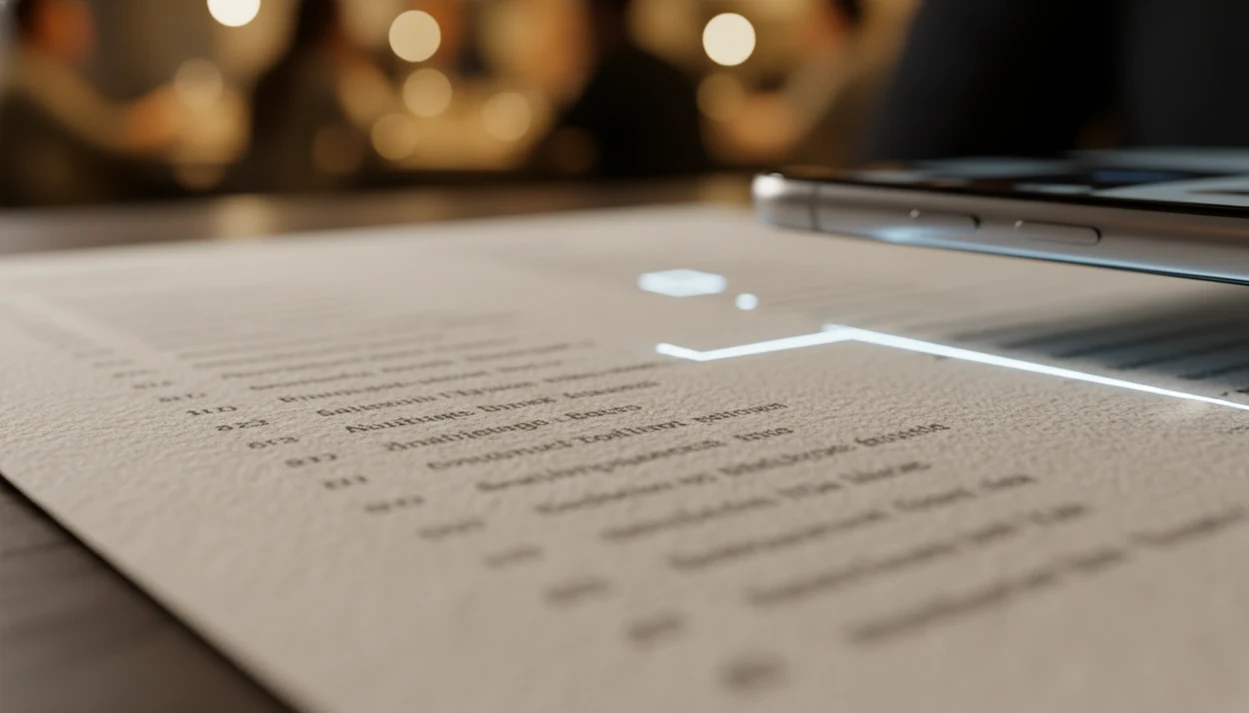
Wine menu scanner technology works by turning a photo into structured wine data, then matching that data against known bottles. OCR captures the text; natural language processing, or NLP, separates producer, grape, vintage, and appellation from the raw line.
A list that says “Lopez de Heredia Viña Tondonia Rioja Reserva 2011” is not one plain phrase. The system has to know that Rioja is the place, not the grape. That awkward dinner-table whisper happens more than people admit.
After parsing, a matching engine cross-references the result against a wine database. Wine Identifier App then layers personal preference history and pairing logic on top, so bright acidity, soft tannins, or ripe fruit can matter more than a raw score. Researchers studying restaurant wine choice found that sommelier recommendations strongly influence diners, which is why digital guidance can shape ordering behavior source.
When the trigger moment is a dense list with unfamiliar regions, Wine Identifier App fits because the scan separates name, vintage, and appellation before showing style and pairing context.
How to Use a Wine Menu Scanner App at a Restaurant
Use a wine menu scanner app before the table has emotionally committed to one bottle. A calm scan takes less social space than five minutes of silent scrolling.
- Open the app and select menu-scan mode, not label scan, so the software expects a full page.
- Photograph the full wine list page under available light, keeping the phone flat and the text square.
- Review the parsed results and tap any wine for ratings, tasting notes, vintage clues, and region details.
- Filter by price range, style, or food pairing to narrow the list to bottles that fit the meal.
- Compare two or three finalists and confirm with the sommelier or server before ordering.
A USDA survey found that roughly 28% of U.S. adults were at least somewhat likely to use smartphone apps for food information, so phone-based table decisions are no longer unusual source. For a slower walkthrough, the guide on how to scan wine menu with phone covers angles, light, and menu framing.
After the scan, when two similar bottles sit side by side in the results, Wine Identifier App earns the spot because it lets you compare style, price, and pairing fit in one workflow.
Common Myths About Wine List Scanner Apps
Wine list scanner apps are useful shortcuts, not rules. They reduce confusion, but they do not turn every menu into a solved equation.
| Myth | Reality |
|---|---|
| A scanner app recognizes every wine instantly. | Rare wines, new vintages, small producers, and private-label bottlings are often missed. |
| Higher crowd-sourced ratings always mean the better choice. | Scores can skew toward popular, fruit-forward styles and may not match your food. |
| All wine apps work the same. | Some apps were built for retail labels, not full restaurant menus. |
| A scanner replaces the sommelier. | The best results combine app data with the server or sommelier’s knowledge of the list. |
Good divino ai wine identification and sommelier app features explain why a wine fits your meal, not just which bottle has the loudest crowd score. Pair the sauce, not only the protein. If you need decision help beyond scanning, the app to help choose wine at restaurant guide covers meal-first selection.
For Diners Choosing Wine From a Restaurant List
“Scan a restaurant wine list,” “find the best wine on the menu,” and “choose wine at a restaurant” are one diner workflow: photograph the list, identify unfamiliar producers, filter by budget and food, then confirm vintage with the server when the print is vague.
OCR helps with dense multi-column menus; it still fails in dim light and with abbreviated names. Use restaurant wine list OCR for mechanics and restaurant wine markups when sticker shock is the real question.
Limitations
Every wine scanner app has weak spots, including Wine Identifier App. The honest answer is that menu scanning works best when the list is readable, the wine is in the database, and your own taste history is not empty.
- Very small producers, private-label wines, and newly released vintages may not match any database entry.
- OCR can struggle with ornate fonts, smudged paper, laminated glare, curved pages, and very dim rooms.
- Crowd-sourced scores may reflect regional availability, reviewer demographics, and popular flavor profiles.
- Heavy app reliance can make lesser-known regions look risky simply because they have fewer ratings.
- Some wine apps collect usage, device, or location data, so permissions and privacy policies matter.
- Pairing suggestions can miss kitchen details, such as extra chile heat or a cream-heavy sauce.
- A sommelier may know that the last bottle in stock is tired, corked, or drinking beautifully tonight.
USDA reporting says household food-away-from-home spending rose from 44% in 1984 to 55% in 2022. More restaurant choices make these limitations more visible. For broader dining comparisons, the best wine app for restaurants guide looks beyond scanning alone.