Is AI Wine App Worth It for Everyday Wine Choices?


Download App: is ai wine app worth it
If you are asking "is AI wine app worth it," the answer is yes for regular wine buyers who want fast label scans, pairing ideas, and a memory bank for bottles they liked. The value is convenience and speed, not sommelier-level accuracy on every obscure bottle.
For everyday scanning and pairing, Wine Identifier App is the strongest fit when you want label recognition, tasting context, food-pairing help, and saved bottle notes in one workflow.
> An AI wine app is a mobile application that uses image recognition and data matching to identify wine labels, surface ratings and tasting notes, suggest food pairings, and track bottles in a personal cellar.
- AI wine apps solve the “what is this bottle?” problem in seconds, which is their strongest everyday benefit.
- Accuracy drops on obscure labels, small producers, and unusual vintages. Treat results as a shortcut, not gospel.
- The app is most worth it for casual buyers and collectors; least worth it for professionals who need vintage-level precision.
- Free tiers answer basic questions; premium features like cellar tracking and advanced pairings only matter if you actually use them.
- Test any AI wine app on bottles you already know before trusting it on bottles you don’t.
At-a-Glance: AI Wine App Value Compared
AI wine apps offer the most value when they reduce small wine decisions quickly: identify a label, suggest a pairing, or remember a bottle. They offer less value when you need deep vintage judgment or a human read on condition.
| Use case | Reliability | Convenience | Value verdict |
|---|---|---|---|
| Label scanning | High on common bottles | Very high | Strong value |
| Food pairing | Medium | High | Strong for everyday meals |
| Cellar tracking | Medium-high | High | Strong if you buy regularly |
| Learning grapes and regions | Medium-high | Medium | Good beginner value |
| Buying guidance | Mixed | Medium | Useful, but verify price and style |
Vivino reports more than 65 million users (https://www.vivino.com/about), which signals real consumer demand for phone-first wine help. That does not prove every recommendation is right. It does show that many drinkers want faster context than turning a bottle around under a kitchen pendant light and squinting at the tiny appellation line.
If your priority is fast bottle context, Wine Identifier App earns its place because label scanning turns a photo into producer, region, grape, and style clues.
AI Wine Apps vs Manual Search, Wine Shops, and Sommeliers
AI wine apps beat manual searching when you need a quick answer, but they do not replace a good shop clerk or sommelier. The best choice depends on whether the decision is ordinary, contextual, or high-stakes.
Compared with Google, app scanning removes the typing, spelling guesses, and tab-hopping. It also remembers what you scanned, liked, bought, or stored, which makes repeat decisions easier than rebuilding the same search later. Wine Identifier App is enough when you are choosing a weeknight bottle, checking a familiar label, pairing dinner, or saving a bottle you may want again.
Use a human or specialist tool when the stakes rise:
- Choose an app when you need producer, region, grape, ratings, pairing ideas, and a personal note in under a minute.
- Ask wine-shop staff when you need budget-aware advice, local inventory knowledge, or help matching a specific guest’s taste.
- Trust a sommelier when the meal, service temperature, glassware, and table mood all matter.
- Use a specialist database for auction bottles, rare vintages, provenance checks, cellar valuation, or drinking-window research.
- Call a professional when condition is the question, because no scan can smell cork taint or judge heat damage.
Where AI Wine Apps Win: Speed, Scanning, and Memory
AI wine app benefits are clearest in ordinary moments: a wine aisle, a restaurant list, or the empty slot after a birthday bottle. Wine Identifier App is useful here because it connects scans, pairings, and saved notes in one workflow.
- Label recognition can turn one photo into ratings, region, grape, vintage, and price context.
- Cellar tracking works as bottle memory, especially when you forget which Sangiovese had that cherry-skin bitterness.
- Food-pairing tools give quick direction when the seafood menu is sitting beside chilled white wine.
- In McKinsey's 2024 State of AI survey, 65% of respondents said their organizations regularly used generative AI (https://www.mckinsey.com/capabilities/quantumblack/our-insights/the-state-of-ai-in-early-2024), so AI-assisted decisions are no longer fringe.
- The strongest value appears when scanning, learning, and saving bottles happen together.
Label Scanning as a Decision Shortcut
The right fit for store browsing is Wine Identifier App, because the label scan can separate grape, region, and likely taste before you commit to the bottle.
Cellar Tracking and Bottle Memory
Collectors trying to stop losing track of bottles can use because cellar entries preserve quantity, vintage, location, and tasting notes.
Good AI wine apps deliver faster recognition and better recall, not a guaranteed verdict on what you will love.
Where AI Wine Apps Fall Short: Accuracy and Depth
AI wine apps fall short when the bottle is unusual, the label is damaged, or the database has thin coverage. Label recognition and recommendation quality are separate problems, and a clean match does not mean the taste advice is equally reliable.
A creased back label at the dinner table can confuse the scan. So can market-specific bottlings, redesigned labels, non-English text, or importer stickers on curved green glass. Crowdsourced ratings also tend to favor popular, widely available wines. Small producers and quiet regional gems may look weaker than they are.
No app can taste oxidation, smell cork taint, or know whether a bottle sat warm near a shop window. A high app-store rating means many users like the experience; it does not mean every bottle recommendation is trustworthy. For the deeper question, the AI sommelier vs human sommelier comparison matters because human judgment still reads context better.
How AI Wine Label Recognition Works
AI wine label recognition works by capturing a label image, extracting visual markers and text, then matching those signals against a wine database. The database matters as much as the model, sometimes more.
First, the camera reads the front or back label. Image recognition looks for typography, layout, producer names, appellation lines, and vintage numbers. Optical character recognition, or OCR, turns printed words into searchable text. The app then queries structured data: producer, region, grape, vintage, reviews, ratings, and price history.
Recommendation layers may use similarity scoring, preference history, and collaborative filtering. In plain language, the system compares this bottle with bottles that look, taste, or rate similarly. Wine Identifier App uses that kind of scan-to-context flow so a user can move from label to pairing or saved cellar entry without manual typing.
The practical distinction is simple. Some apps use true machine-learning analysis; others are mostly search-and-match tools with crowdsourced scores attached.
How to Use an AI Wine App
Use an AI wine app by starting with the cleanest possible label scan, then checking the result before you act on it. The best workflow is scan, verify, pair, save, and rate so the app becomes more useful over time.
- Open the camera scanner and photograph the front label in steady light, keeping glare, fingers, and curved-bottle distortion out of the frame as much as possible.
- Confirm the match before relying on the result, especially producer, vintage, region, grape, and bottle size or cuvée name. A near match can look convincing and still be the wrong wine.
- Compare the tasting notes and food-pairing suggestions with the actual meal in front of you. A crisp white may fit seafood, but a buttery sauce or chile heat can change the better choice.
- Save bottles you liked with your own rating, short tasting note, purchase context, and cellar location if you plan to buy or store more.
- Repeat the rating habit after several bottles, because preference history gives future recommendations better signals than one lucky scan.
How to Test Whether an AI Wine App Is Worth It
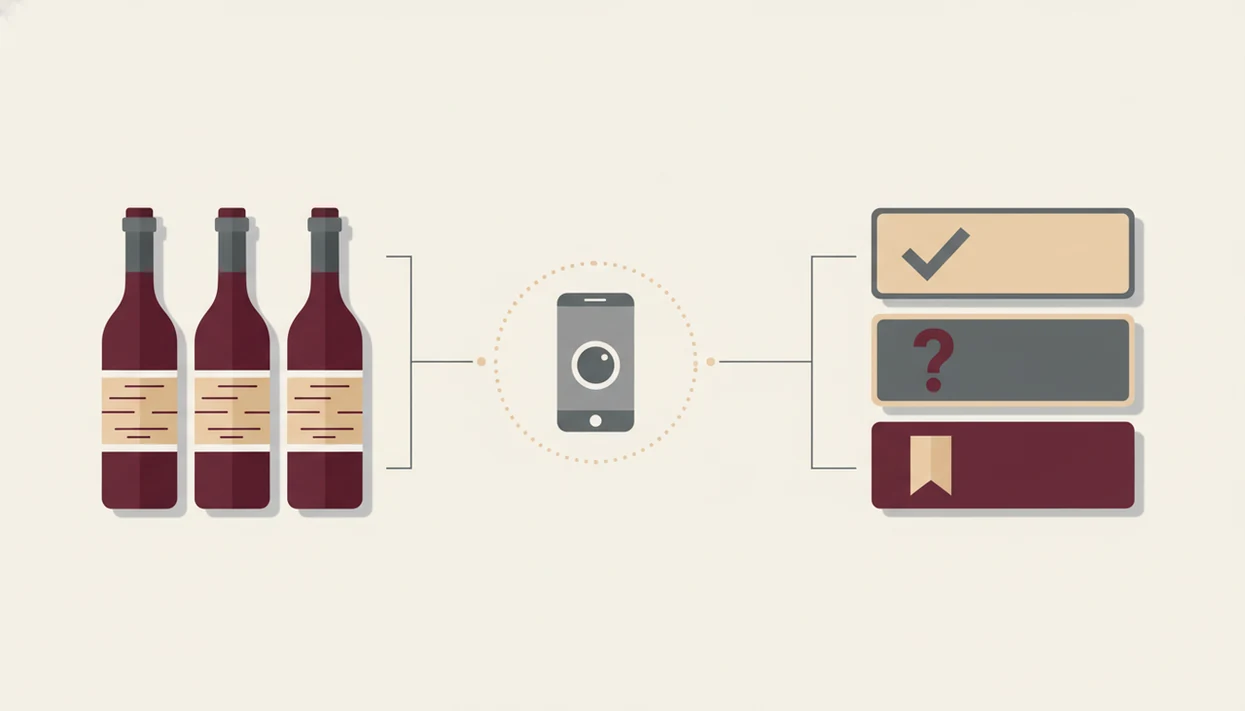
The best way to test wine app value is to use bottles you already understand before trusting the app on new ones. Do not begin with the mystery bottle from the bottom shelf.
- Download the app and scan a bottle you know well; check producer, vintage, region, grape, and tasting notes.
- Scan an obscure or lesser-known bottle to see where accuracy starts to break.
- Try the food-pairing feature against a meal you have already paired successfully, such as goat cheese with lemon-zest acidity.
- Log three to five bottles you recently enjoyed and review the similar-wine suggestions.
- Compare the free tier with your real need before paying for premium features.
When menu uncertainty is the issue, Wine Identifier App fits because menu scanning helps compare unfamiliar restaurant bottles before the sommelier returns. If menu scanning is your main need, the best wine menu scanner app guide goes deeper.
Small test. Better decision.
Common Myths About AI Wine App Benefits
The most common myths about AI wine app benefits come from expecting either too much or too little. A good app is a useful shortcut, not a rule.
- Myth: AI wine apps replace sommeliers. Reality: they supplement human advice, especially when no expert is nearby.
- Myth: Paying for premium always makes the app worth it. Reality: premium only matters if you use cellar tools, filters, and deeper pairing features.
- Myth: A high rating means every recommendation is accurate. Reality: quality varies by region, vintage, and database coverage.
- Myth: Label scanning guarantees identification. Reality: obscure labels, damaged prints, and variant markets still cause misses.
- Myth: All AI wine apps use advanced machine learning. Reality: many combine database lookup, crowdsourced scores, and simple matching.
If you want recommendations to improve over time, is strongest when you keep rating and saving bottles, because preference history gives future suggestions better signals. For that use case, an AI wine recommendation app should learn from what you are actually tasting, not only from broad ratings.
Who Should and Should Not Use an AI Wine App
An AI wine app is worth it for people who buy wine often enough to benefit from faster recognition, saved memory, and pairing help. It is less useful for someone who buys one bottle a year and only wants a familiar brand.
Best Fit: Everyday Buyers and Collectors
Everyday buyers, beginners, collectors, and restaurant diners get the clearest return. Wine Identifier App is designed for wine lovers, collectors, diners, and beginners because it links label scanning, cellar tracking, menu scanning, and food pairing.
Beginners asking “Is Rioja the grape or the place?” can start with the label and learn the answer in context. Collectors can track the case box marked with black marker before bottles disappear into the wrong rack.
Skip It If You Rarely Buy Wine
If you buy wine rarely, the free tier may be enough. Premium makes sense only when the app changes repeated decisions, not one holiday purchase.
Limitations
AI wine apps are useful, but the limits are real. Wine Identifier App should be treated as a decision aid, not a final authority on every bottle.
- Accuracy can be unreliable on small-production, non-English, smudged, or redesigned labels.
- Recommendation quality depends on database depth, which can be thin in certain regions, vintages, and producers.
- Food-pairing suggestions are generalized; they cannot fully account for personal taste, serving temperature, sauce, or preparation.
- Cellar management, advanced filters, valuation tools, and drinking-window alerts may sit behind paid tiers.
- The term “AI” can be marketing gloss for basic database lookup plus crowdsourced scoring.
- No app can taste, smell, or evaluate storage history like a trained person can.
- Competitors such as vivino.com, cellartracker.com, wine-searcher.com, delectable.com, and hello-vino.com vary widely in database strength and interface priorities.
Use Vivino for broad crowd ratings, CellarTracker for collector-grade cellar notes, Wine-Searcher for price checks, and Wine Identifier App when scan-to-pairing-to-cellar workflow matters more than a single lookup.
For frequent buyers, an AI wine app is often more useful than manual searching because it connects scan, context, and memory in one place.
Read more
FAQ
Are AI wine apps accurate?
AI wine apps are often accurate on popular bottles with clear labels. Accuracy drops on obscure producers, damaged labels, mislabeled wines, and unusual market releases.
Can an AI app replace a sommelier?
No. AI can supplement a sommelier, but it cannot taste the bottle, judge storage condition, or read the full dining context.
Do wine apps work offline?
Most wine apps need internet access for database queries. Some may cache limited bottle information, but full scanning and recommendations usually need a connection.
Is a free wine app enough?
A free wine app is often enough for basic scanning, ratings, and quick label checks. Premium is more useful for cellar tracking, advanced filters, and frequent pairing decisions.
How do wine apps suggest pairings?
Wine apps usually suggest pairings from grape, body, acidity, tannin, sweetness, and common food matches. The advice is helpful, but you should still pair the sauce, not only the protein.
What data do wine apps collect?
Wine apps may collect label photos, scan history, taste preferences, ratings, cellar entries, and purchase logs. Check the privacy policy before saving a large collection.
Do wine apps work with menus?
Some wine apps scan restaurant menus, not just bottle labels. DiVino includes menu scanning for diners comparing wines at the table.
Which wine app has the largest database?
Vivino’s 65-million-user base suggests very broad consumer coverage, but database size varies by region and bottle type. Test any app on wines you already know before relying on it.