Restaurants and wine lists
How to order wine at a restaurant: one evening, start to first pour
To order wine at a restaurant, decide your budget and the style you like, read the list for price and style before names, tell the sommelier what you are eating and what you want to spend, smell and taste the first pour only to check for faults, then send it back only if it is flawed.


By AppDivino team · Published
Before you leave the house
Say it's a Friday, a table for four, and a list you haven't seen yet. The easiest win happens before you walk in: agree a number. Not a secret number, a shared one. Tell the group "we're around the same figure for the bottle" and the awkward part is gone before the bread arrives.
Then think about what you actually like. Not region names, just words. Crisp or round? Light or heavy? Lots of oak or none? Those words are what a sommelier needs, and they are worth more than any grape you could name.
If the restaurant posts its menu online, glance at it. Knowing you'll have the roast chicken or the short rib narrows the wine list before you open it.
Sitting down: the list arrives
Don't open it right away if people are still settling in. Order water, let the table talk, and read the list when you have a minute of quiet. Nobody is timing you, even if it feels that way.
A phone comes in handy at this point. A wine menu scanner reads a photographed list and sorts bottles against your taste, which is handy when the list runs to dozens of pages and the names are in a language you don't read. We make DiVino for that moment: photograph the wine list and it finds bottles that fit your taste. Results depend on a clear, well-lit shot, so tilt the page away from candle glare.
If you're on Apple, the wine menu app you want is just DiVino from the App Store (it needs iOS 18 or later). On Android, you get the same sommelier app, DiVino, from Google Play. It's free to download and start, and no account is needed.
How to read a wine list
Most lists are organized by color, then region or style, then price. Read the section headings first; they tell you where the list is strong. A list with forty Burgundies and four Spanish reds is telling you something about the owner's taste.
Each line usually gives the producer, the wine or appellation, the vintage and the price. The vintage is the harvest year. Two bottles of the same wine from different years can taste quite different, so check it.
Look at the by-the-glass list too. It shows what the kitchen thinks goes with its own food, and it's a low-risk way to try something before committing to a bottle.
- Read the headings before the names.
- Find the price range you agreed on, and ignore everything outside it for now.
- Circle two or three bottles, not ten.
Understanding the price column
Restaurants charge more than a shop does for the same bottle; that's normal. How restaurants mark up wine varies a great deal, and it often falls harder on cheap bottles than on expensive ones in terms of what you get for your money. We would skip the very cheapest wines on a list more often than not, and we'd look for the middle of the range from a producer you don't know, where the restaurant has often chosen with care.
The old trick of ordering the second-cheapest bottle is well known to restaurants. Skip it. Pick by style instead.
Talking to the sommelier
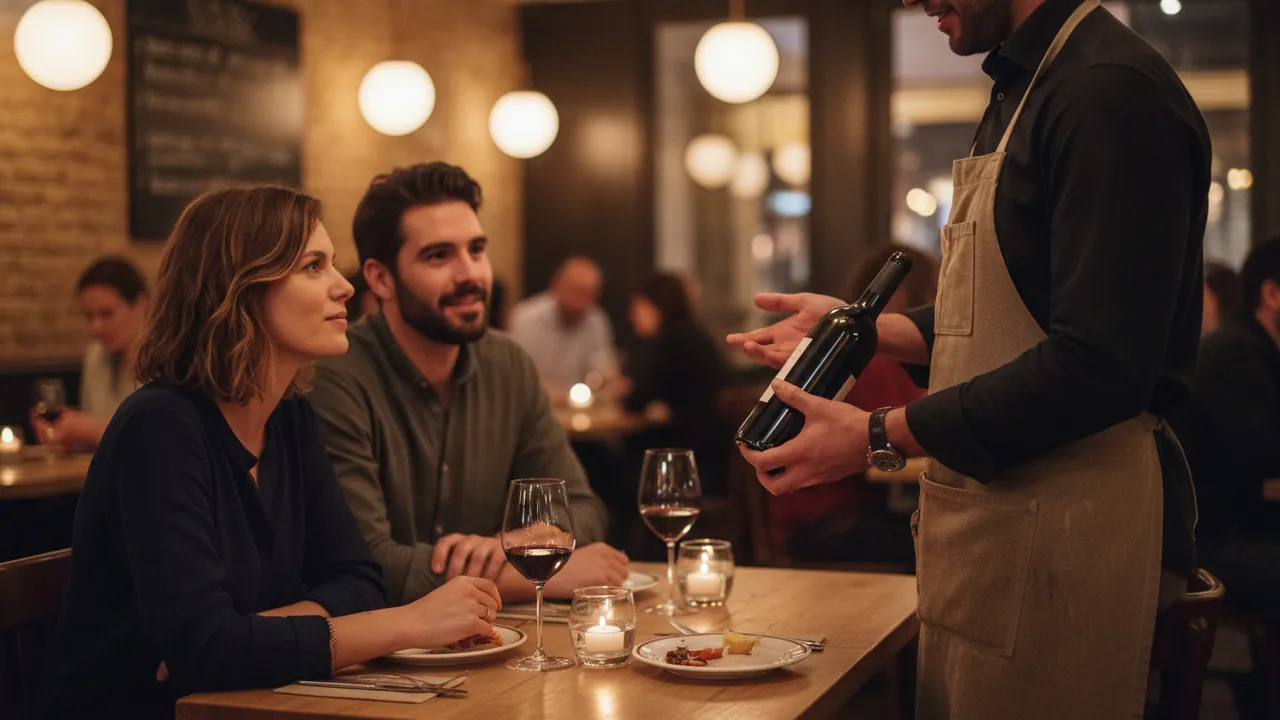
This is the part people dread, and it's the easiest. Sommeliers want to be asked. What to say to a sommelier comes down to three things: what you're eating, what you like, and what you're spending.
Something like: "We're having the ribeye and a mushroom pasta, we like medium-bodied reds without too much oak, and we're around the price of this one." Point at the line on the list instead of saying the number out loud. That's perfectly polite, and it's what sommeliers expect.
If you're unsure what to drink with steak, say "steak" and name the cut; a sommelier will take it from there. Wine knowledge is not a test. "I don't know much, I'd like your help" is a fine opening.
On AI sommelier vs human sommelier: an app is quick and private and has no judgment, but a person can tell you what's open tonight, what's drinking well, and what the kitchen is doing with the sauce. We think the best evening uses both: scan to get your bearings, then ask the person.
Choosing for a mixed table
When one person has fish and another has lamb, don't try to match every plate. Pick a versatile bottle: a sparkling wine, a dry rosé, a lighter red or a white with good acidity. Understanding how pairing works helps here; acidity, tannin, weight and sweetness are what move a match, more than the protein itself.
When you pick a wine for dinner, what's simmering in the sauce usually matters more than which meat is on the plate. Lemon butter and tomato sauce are different conversations even on the same fish.
The first pour and the tasting ritual
This is the moment people overthink. The server shows you the bottle: check the producer, wine and vintage match what you ordered. That's the whole purpose of that step.
Then the cork, which they may set on the table. You don't need to sniff it; it's just a sign the bottle was sealed. Then comes a small pour for you. Smell it, taste it, and ask yourself one question: is anything wrong?
The wine tasting ritual at a restaurant is not a vote on whether you like it. It's a fault check. A wet cardboard or damp basement smell, or a flat, stale taste, suggests a faulty bottle. Nod, say "that's fine," and let them pour for the table.
When to send a bottle back
Send it back if it smells of damp cardboard, tastes sharp and vinegary, or seems cooked and flat. Say it simply: "I think there may be something off with this one, could you check it?" A good restaurant will taste it and swap it without fuss.
Don't send it back because you chose badly and don't love the style. That's your pick, not a fault. If you're honestly unsure, ask the sommelier to taste it with you.
A bottle that's too warm or too cold isn't spoiled either; ask for an ice bucket or a few minutes on the table.
Afterwards, and what to do differently next time
If you loved the wine, photograph the label before it leaves the table. DiVino identifies the producer, wine and vintage from a label and keeps your notes in a tasting journal on your device. Check the year on the bottle yourself, because the vintage on similar labels can be misread.
Next time, do three things differently. Agree the budget before you arrive. Read headings first, not names. And ask the sommelier a specific question instead of "what's good?". Order a bottle only after you've settled on the style, and the whole evening gets easier.
Frequently asked questions
How do I know if a wine is corked at a restaurant?
A corked wine smells like wet cardboard, damp basement or moldy newspaper, and the fruit tastes flat and muted. The cause is a compound called TCA, and a bottle with this fault is a legitimate reason to ask for a replacement.
Who is supposed to taste the wine at the table?
Traditionally the person who ordered the bottle tastes it, though any adult at the table can do it. The taster only checks for faults such as cork taint or spoilage, not whether the wine matches personal taste.
How much should I spend on a bottle of wine at a restaurant?
Spend whatever fits your budget; there is no correct number. Restaurant bottles are commonly marked up well above shop prices, so the second or third cheapest options on the list often give good value without looking like the bottom of the list.
Can I send a wine back if I just don't like it?
Generally no, because a wine you simply dislike is not a faulty wine. Many restaurants will be flexible if the sommelier recommended it and it was not what you described, but a flaw such as cork taint, oxidation or vinegar smell is the clear case for sending it back.
Should I order wine by the glass or by the bottle?
Order by the bottle when two or more people will drink wine, since it usually costs less per glass and gives a better choice. A glass makes more sense when you are dining alone, when each person wants something different, or when you want to try a style before committing.
Do I have to tip the sommelier separately?
Usually not, because the tip is typically included in the total check that goes to the service team. If a sommelier gave exceptional help, some diners add extra to the tip or hand it over directly, but this is a courtesy and not a requirement.