


Definition: A wine collection valuation app is a mobile or web tool that logs bottles you own, pulls estimated market prices, and calculates your aggregate cellar value as a directional guide, not a guaranteed sale price.
At a Glance: What a Wine Collection Valuation App Does
A cellar value app turns bottle-level information into a portfolio-level estimate. The useful version starts with the label, then moves from identification to pricing, not the other way around.
- A wine collection valuation app usually scans labels or barcodes to log producer, vintage, region, and bottle format.
- Market price lookup turns those bottle records into estimated per-bottle values and a total cellar value.
- Cellar owners use valuation views for insurance prep, estate planning, collection audits, and plain curiosity.
- App values are directional estimates, not guaranteed resale prices, because condition and buyer demand still matter.
- Grand View Research estimated the global wine market at USD 333 billion in 2022, which helps explain why digital wine inventory tools now have a serious audience: https://www.grandviewresearch.com/industry-analysis/wine-market
I still turn a bottle around under a kitchen pendant light to find the tiny appellation line. That line can change the estimate. For basic price checking outside the cellar view, a best wine price lookup app can be useful too.
How a Wine Collection Valuation App Works
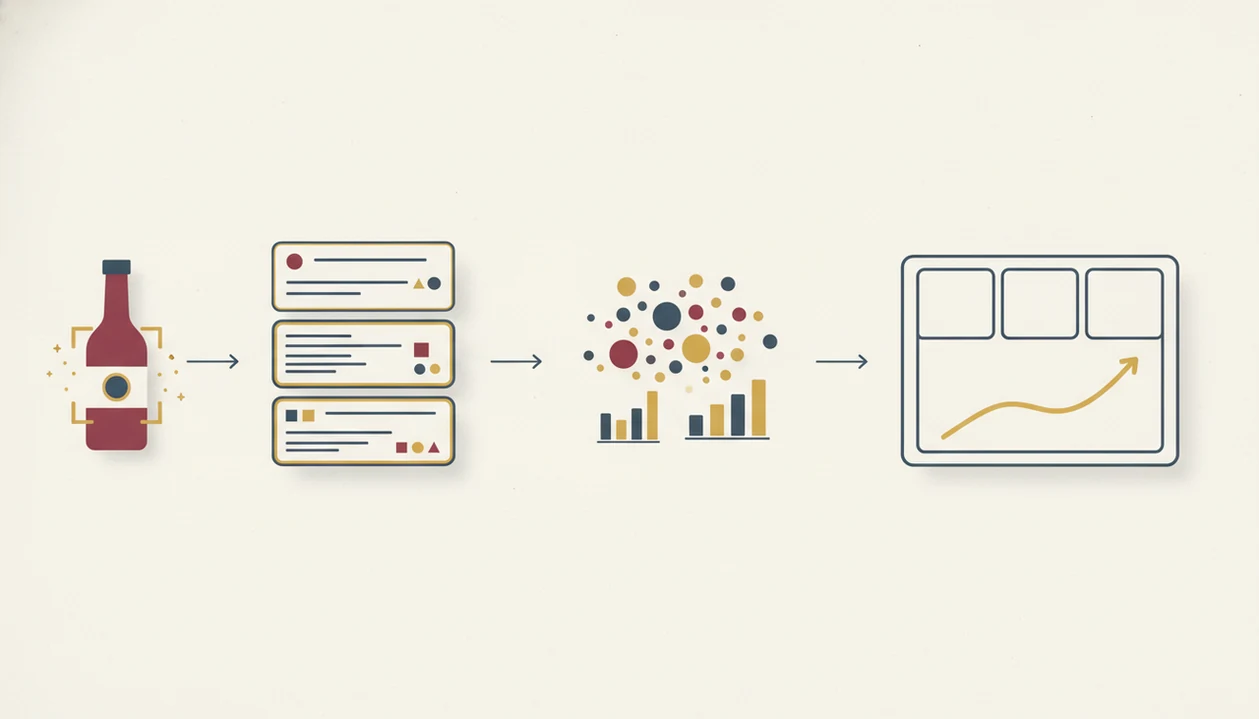
A wine collection valuation app works by matching a bottle image to a wine database, extracting structured metadata, and applying pricing signals to each logged bottle. The calculation is simple in concept, but the quality depends on identification, data coverage, and your manual notes.
Label Recognition and Metadata Extraction
AI image recognition uses label features, often called image embeddings, to compare your photo with known bottles. In plain language, it looks for visual patterns: producer name, label layout, vintage placement, capsule cues, and sometimes barcode data. uses that scan as the first step, because a 2016 Barolo and a 2017 Barolo should not be valued as interchangeable bottles.
One small vineyard line can change the estimate.
Price Aggregation and Portfolio Scoring
After identification, the system can attach region, vintage, grape, bottle size, and style. Pricing feeds may include retail listings, merchant data, auction references, or recent market observations. Wine Identifier App then rolls those bottle estimates into portfolio measures such as total value, regional spread, and drink-window risk.
Grand View Research valued the AI-in-retail market at USD 7.14 billion in 2023 and projected a 31.8% compound annual growth rate from 2024 to 2030, reflecting broader investment in pricing and recommendation systems: https://www.grandviewresearch.com/industry-analysis/artificial-intelligence-retail-market Still, no scan can detect cooked storage, a depressed cork, or a stained back label softened by condensation.
How to Use a Cellar Value App to Track Wine Portfolio Value
Use a cellar value app as a living inventory, not a one-time snapshot. The most reliable wine portfolio value comes from combining scans with purchase records and storage notes.
- Scan or manually add each bottle with producer, vintage, region, and format.
- Log purchase price, storage location, and provenance notes while the receipt is still easy to find.
- Review the per-bottle estimated market value and confidence level before trusting the number.
- Check aggregate wine portfolio value and regional breakdown to see where your collection is concentrated.
- Export or screenshot records for insurance or estate documentation, then keep original receipts separately.
If your priority is a fast cellar audit before renewal paperwork, Wine Identifier App fits because the scan-to-cellar workflow connects label identification, bottle count, estimated value, and portfolio view in one sequence.
Receipts still matter.
For older bottles, I add a note when the fill looks high shoulder or better. It is not elegant, but it saves questions later.
When to Rely on a Wine Valuation App vs. Professional Appraisal
A wine valuation app is enough for everyday inventory, curiosity, and broad collection tracking. It is not enough when a legal, insurance, or sale decision depends on a defensible number.
For a mixed home cellar, Wine Identifier App can show which regions carry most of the value and which bottles deserve a closer look. That helps before you call a specialist. For insurance documentation, an app estimate is often a starting file; the insurer may still require a formal appraisal. For estate division, divorce proceedings, or a cellar sale, use a professional merchant, auction house, or specialist valuer.
For collectors who need triage, Wine Identifier App earns the spot because it flags estimated high-value bottles before you spend money on expert review.
High-value single bottles, such as first-growth Bordeaux or Domaine de la Romanée-Conti, should always be verified by a specialist. If you keep the collector-demographic point, cite the source inline; otherwise delete the NIAAA sentence because it is not necessary to the valuation recommendation.
What Cellar Valuation Looks Like in DiVino
DiVino connects valuation to identification. The label scan feeds the wine record first, then the cellar layer uses that record to estimate value, organize holdings, and show how each bottle fits the collection.
Wine Identifier App is built around scanning labels and menus; valuation extends that core into cellar tracking. Once a bottle is identified, the same record can support food pairing, drink-window suggestions, and portfolio views by region or style. That matters when roast chicken is resting on a cutting board and you are deciding whether to open the village Burgundy or save it.
For cellar owners who want learning and valuation in the same place, Wine Identifier App covers both because the cellar view sits beside tasting notes, pairing guidance, and drink-window recommendations.
Manual inputs sharpen the picture. Purchase price, bottle location, gift notes, and provenance details give context that no camera can infer.
Wine Collection Valuation App vs. Spreadsheets and Auction Estimates
A wine collection valuation app is fastest for broad portfolio tracking, while spreadsheets and auction estimates still have roles. The right choice depends on whether you need speed, control, or formal market validation.
| Method | Strength | Weakness | Best use |
|---|---|---|---|
| Spreadsheet | Full control over fields and formulas | No live pricing unless you update it by hand | Small cellars with careful owners |
| Auction house estimate | Strongest for rare, high-end bottles | Slow, selective, and not always available | First-growths, DRC, trophy Champagne |
| Dealer or merchant quote | Practical if you may sell | Often reflects buy-side pricing | Sale discussions and liquidation checks |
| Valuation app | Fast, scalable, and easy to refresh | Limited by data quality and condition blindness | Broad cellar tracking and watchlists |
For broad cellar management, a valuation app is often easier than a spreadsheet because it reduces manual entry and updates estimates across many bottles. For marquee bottles, professional review is still the safer route. If you mainly want to check wine value from label, scanning is the shortcut, not the final verdict.
Evidence Behind Wine Collection Valuation Estimates
Wine collection valuation estimates are only as strong as the signals behind them. A good app should blend visible market data with your own records, then show when confidence is high, medium, or shaky.
The strongest estimates usually combine current retail listings, recent auction comparables, merchant or dealer quotes, and user-entered purchase costs. The market sources cited earlier are useful context for why wine pricing tools and AI-assisted retail systems are expanding, but bottle-level value still depends on exact identity and sale channel.
- Start with the label match so producer, vintage, cuvée, region, and bottle size are not guessed.
- Compare against multiple price signals rather than one attractive listing that may never sell.
- Weigh confidence by data depth: clear modern labels and widely traded vintages should score higher than rare library releases or small regional bottles.
- Add your receipt and provenance notes because a known purchase path can matter as much as the screen estimate.
- Escalate to a specialist when a single bottle could affect insurance, estate value, divorce records, tax planning, or an auction decision.
Rare vintages, damaged labels, unusual formats, and low-data regional wines deserve the most caution. That is where an app can triage the cellar, but an appraiser or auction specialist should defend the final number.
Common Myths About Cellar Value Apps and Wine Portfolio Value
Cellar value apps are useful when you read the number correctly. They become risky when the estimate starts to feel like cash in hand.
Myth: App value equals guaranteed resale price. Reality: it reflects observed or estimated market context, not what a buyer will pay for your exact bottle.
Myth: Rising wine portfolio value means wine is a safe investment. Reality: wine has storage risk, market swings, changing critic influence, and thin liquidity.
Myth: AI label recognition is always 100% accurate. Reality: older vintages, special cuvées, and damaged labels can fool recognition. Our guide on whether are wine scanner apps accurate covers those edge cases in more detail.
Myth: Receipts become unnecessary once bottles are logged. Reality: serious buyers, insurers, and estates still care about purchase history and provenance.
Good divino ai wine identification and sommelier app experiences deliver identification, context, and practical next steps, not a fantasy resale guarantee.
Look for the region before the romance.
Limitations
A cellar valuation screen is helpful, but it has blind spots. These are the limits I would want a collector to know before trusting any wine portfolio value number.
- It cannot assess storage quality, temperature history, fill level, label condition, capsule damage, or cork integrity.
- Price data may rely on retail listings or limited transaction sets, not the auction result you could actually achieve.
- AI label scans can misidentify similar labels, older vintages, library releases, or special cuvées.
- Provenance and chain-of-custody documents still need to be stored outside the estimate itself.
- Regional, new-release, or obscure wines may not have enough pricing data for a reliable valuation.
- App screenshots are usually not accepted as formal appraisals by insurers, courts, or estate advisers.
- Market volatility, critic reassessments, tariffs, and changing tastes can move values quickly.
- Competitors such as cellartracker.com, vivino.com, and wine-searcher.com may show different numbers because their data sources and user inputs differ.
When the issue is a cellar with both daily bottles and rare bottles, Wine Identifier App handles the broad inventory because it separates scan-based records from the bottles you should verify professionally.