Tool That Can Compare Wine Prices by Vintage, Retailer, and Region

A tool that can compare wine prices aggregates merchant listings so you can see side-by-side costs for the same bottle, vintage, and size in seconds. Prices vary by taxes, shipping, regional availability, and vintage scarcity, so treat results as indicative market values, not guaranteed checkout totals. These tools work best when paired with label recognition, pairing notes, and cellar context, because price alone does not tell you whether the bottle fits the meal or occasion.
Definition: A wine price comparison tool is a website or app that indexes merchant listings to display the current market range for a specific wine by name, vintage, and bottle size, helping buyers identify fair prices across retailers.
TL;DR
- Wine price comparison tools pull prices from tens of thousands of merchants and millions of listings to show you the going rate for any bottle.
- Price differences for the same wine can be significant due to taxes, shipping, vintage scarcity, and retailer strategy, so always check multiple sellers.
- The strongest workflow combines price comparison with label recognition, tasting notes, food pairing, and cellar tracking, so the cheapest bottle is not treated as automatically best.
What a Wine Price Comparison Tool Actually Does
A wine price comparison tool shows the current market range for a specific wine, usually by matching the name, producer, vintage, bottle size, and region across merchant listings. It is a pricing map, not a promise that every bottle is available at that exact number.
Most large tools aggregate offers from tens of thousands of merchants and millions of listings. A good result page may show the lowest listing, average range, critic scores, grape, region, and sometimes pairing notes. That context matters when two bottles look similar on price but taste very different.
Start with the label.
If I turn a bottle around under a kitchen pendant light, I’m looking first for the tiny appellation line, then the vintage. A 2019 Rioja Crianza and a 2016 Rioja Reserva should not be compared as the same bottle. For vintage detail, a wine vintage lookup app can help separate the label romance from the actual year.
Five Facts About Comparing Wine Prices Online
- Modern wine price comparison tools can aggregate listings from tens of thousands of merchants in seconds, but their coverage still depends on participating retailers and crawlable pages.
- Label scanning or name search usually triggers side-by-side prices with critic scores, regions, grapes, and sometimes pairing information.
- Price variation across merchants can be substantial because taxes, shipping, scarcity, allocation, and retailer strategy all affect the final cost.
- Indicative market values do not account for bottle condition, provenance, cork health, fill level, or storage history.
- Pairing comparison with AI sommelier features helps close the gap between ‘Is this fair?’ and ‘Will I actually like it?’
A useful shortcut, not a rule.
For everyday buying, compare wine prices before you treat one store’s shelf tag as the market. For collectible buying, a listing is only the beginning. The wine price lookup vs wine value distinction matters most when the bottle is older, rare, or stored by an unknown seller.
How Wine Price Comparison Works Behind the Scenes
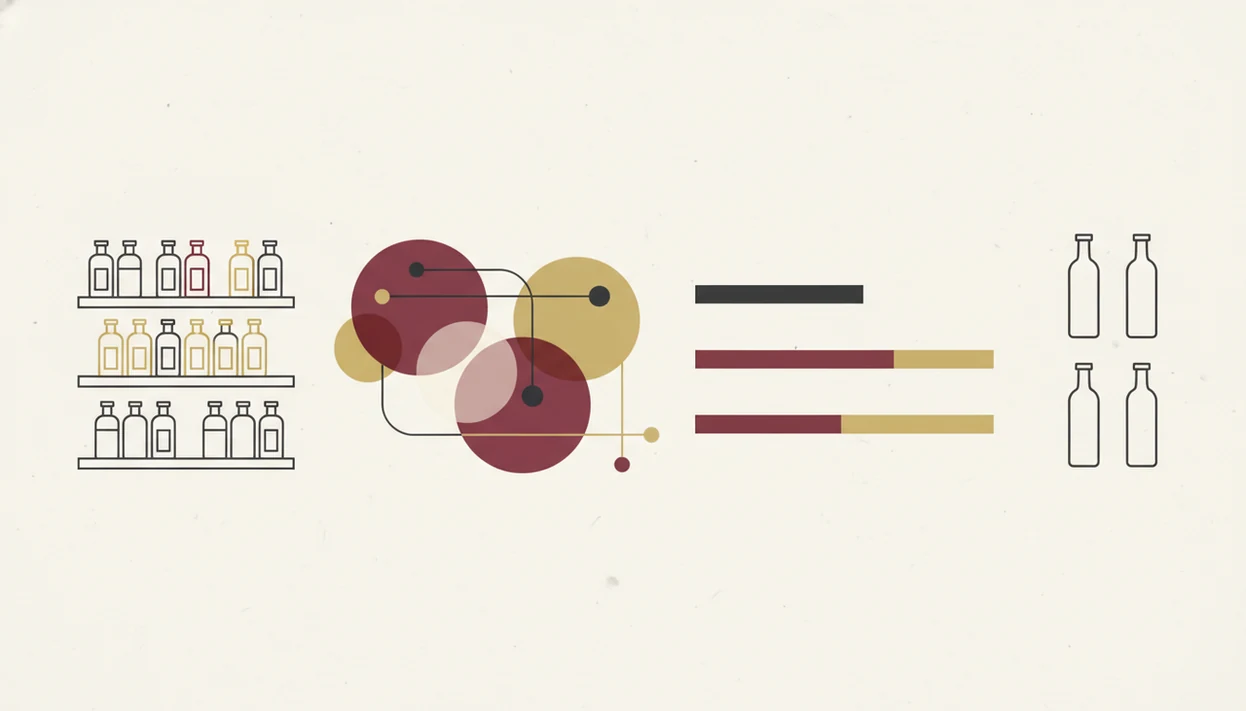
Wine price comparison works by collecting merchant data, indexing each offer, then using matching algorithms to normalize wine names, vintages, bottle sizes, and regions. In plain language, the tool tries to decide whether several messy listings describe the same bottle.
Data Feeds and Merchant Indexing
Some prices come from merchant data feeds. Others come from web crawling, where software reads public shop pages and extracts price, stock, location, and shipping notes. Freshness matters. A flash discount can vanish before the index refreshes.
Matching Wine by Vintage, Size, and Region
Matching systems use text normalization and entity matching. “Ch.,” “Château,” 750 ml, magnum, Napa Valley, and a single-vineyard name all need careful handling. According to an OECD analysis, online price dispersion is common, and online retailers may show wider variation than traditional stores source. AI label recognition can start the right search, but the final match still needs a human glance.
Before You Compare Wine Prices
Before you compare wine prices, gather the details that make one bottle different from another. A clean match starts with identity, bottle size, and destination, not the first low number on a results page.
- Confirm the exact wine. Read the producer, cuvée or vineyard name, vintage, region, and appellation from the label. A small word on the front label can separate a basic bottling from a reserve or single-site release.
- Decide what kind of answer you need. For a Tuesday dinner bottle, everyday price context may be enough. For an older Bordeaux, Burgundy, Napa Cabernet, or rare Champagne, you are closer to collectible valuation, where condition and provenance matter.
- Set your shipping destination first. Headline prices can change once taxes, delivery rules, state restrictions, or import costs appear.
- Photograph the bottle clearly. Shoot the front and back label in flat, steady light, with the glass upright and glare reduced. The back label often carries importer, alcohol, and region clues.
- Check the format and release. Make sure you are comparing a standard 750 ml bottle with another 750 ml bottle, not a magnum, half-bottle, library release, anniversary label, or special allocation.
Why Wine Prices Vary So Much Across Retailers
Wine prices vary because the same bottle can carry different taxes, import duties, shipping costs, retailer margins, and scarcity signals in different places. One shop may discount to clear inventory. Another may raise price because it has the last few bottles of a desired vintage.
The market is large enough for those differences to matter. In 2023, global wine consumption was estimated at 232 million hectoliters, and the United States consumed about 33.3 million hectoliters, according to the OIV source. That makes the U.S. a natural market for wine price comparison.
A sticky note with a drinking window on a cellar bottle tells a quieter story. Scarcity is not only global. It can be one vintage, one importer, one local allocation. For everyday buyers, the lowest shelf price may still lose once shipping, duties, and minimum-order thresholds appear at checkout.
How to Use a Tool That Can Compare Wine Prices
Use a wine price comparison tool by narrowing the bottle first, then comparing total cost rather than the headline listing. The cleanest process is slow for about thirty seconds, then fast.
- Scan the label or search by wine name and vintage. Confirm the producer, cuvée, region, and year before trusting results.
- Filter by bottle size, vintage year, and shipping region. A 750 ml bottle and a magnum should never share one price judgment.
- Review side-by-side prices with critic scores and tasting notes. Look for the region before the romance.
- Check total cost including shipping, taxes, and minimum-order rules. The cheapest listing can become the expensive one.
- Cross-reference pairing and cellar context. Tools like Wine Identifier App can add food pairing, label recognition, and cellar tracking to the price check.
For a phone-first workflow, Wine Identifier App divino ai wine identification and sommelier app delivers bottle identity and taste context, not a blind race to the lowest number.
Everyday Scenarios for Wine Price Comparison
Wine price comparison is useful outside auctions and collector cellars. It helps during grocery shopping, restaurant ordering, travel, and online buying, where the same bottle can look fair in one setting and inflated in another.
Scanning Wine at the Store or Restaurant
At the store, a quick scan can tell you whether a weekday Chianti is close to market or carrying a big markup. At dinner, with a phone tucked behind the water glass, a menu scan can give a retail benchmark before friends debate bottles over shared appetizers. Pairing still matters, especially if the sauce is sharp or creamy.
Comparing Wine Prices While Traveling
Travel and duty-free shops complicate the math. Currency, taxes, baggage limits, and local availability all change the answer. UNCTAD reported that food and personal care e-commerce reached 7.2% of global retail sales in 2023, so digital checks now fit normal shopping behavior. If price pushes you away from a label, use find cheaper similar wines by style, grape, and region.
Common Mistakes When You Compare Wine Prices
The most common mistake is treating the lowest visible price as the final price. Shipping, taxes, and minimum-order requirements often appear late, after the bottle already feels like a bargain.
Another mistake is ignoring vintage. Same producer, same label, different year, very different value. A warm vintage may bring ripe fruit, not just sweet fruit. A cooler one may show brighter acidity and a leaner frame.
Don’t treat an average online price as investment-grade valuation. A few stale listings can distort the range. Also, do not trust a scan without checking the exact wine name, vintage, and bottle size. Smudged back labels after condensation has softened the paper are easy to misread. For scan reliability, the practical question is covered in are wine scanner apps accurate.
Verifying Your Wine Price Comparison Results
Verify a wine price result by checking the merchant page before you buy. Confirm the vintage, bottle size, producer name, and shipping destination there, not only inside the comparison tool.
Look for a listing date or last-updated timestamp. If the merchant page says “sold out,” the comparison result is stale. If the retailer does not ship to your state or country, the price is informational only.
One small habit helps.
Use AI identification to confirm the exact bottle, then compare the merchant listing against the physical label. A check wine value from label workflow is most useful when it treats the scan as a starting point, not the final verdict.
Limitations
Wine price comparison tools are useful, but they have real limits. They can reduce guesswork. They cannot replace careful buying judgment.
- Prices can be outdated, incomplete, or temporarily wrong during promotions, stockouts, or delayed merchant updates.
- Tools cannot assess bottle condition, storage quality, authenticity, cork health, fill level, or heat exposure.
- Coverage is uneven. Some regions, small wineries, local shops, and allocation-only releases may be missing.
- Label-scanning AI can misread poorly lit, damaged, curved, or look-alike labels.
- Lowest listed price may ignore shipping, taxes, import duties, and minimum-order thresholds.
- Large platforms still index only a subset of merchants, so limited-release wines can escape comparison.
- Collectible bottles need provenance checks and, for serious value, professional appraisal.
Chalky grip on the gums from young Nebbiolo tells you something price cannot. So does a seller who can explain where the bottle slept for ten years.
FAQ
Are wine comparison prices guaranteed?
No. Wine comparison prices are indicative listings and may not include final checkout costs such as taxes, shipping, insurance, or retailer fees.
Can I compare wine prices by vintage?
Yes. Most wine price tools let you filter or sort by vintage year, which matters because different vintages of the same label can have different scarcity and quality.
Do wine price tools include shipping?
Most tools show the base listing price first. You usually need to open the retailer page to confirm shipping, taxes, and minimum-order rules.
Which app scans labels for wine prices?
Several wine apps use label scanning to identify a bottle and trigger price lookups. Wine Identifier App is useful when the scan also needs tasting notes, pairing context, and cellar organization.
Should price be the only factor when choosing wine?
No. Price is only one signal. Confirm the exact bottle, vintage, bottle size, seller reputation, shipping cost, and whether the wine style fits the meal or occasion.
Why do wine prices vary by store?
Wine prices vary by store because of taxes, shipping models, allocation, retailer margin, promotional pricing, and regional availability. The same bottle can have different total costs in different markets.
Are online wine prices lower than retail?
Online wine prices can be lower or higher than local retail. Price dispersion is common, so the useful comparison is total delivered cost against a nearby shelf price.
Can price tools value collectible wines?
Price tools show market listings, not a full collectible valuation. Rare bottles require condition review, provenance checks, storage history, and sometimes professional appraisal.