Wine Price Lookup vs Wine Value: What the Number on the Tag Really Means


Download App: wine price lookup vs wine value
Wine price lookup vs wine value comes down to a simple split: a price lookup tells you the current retail or auction going rate for a specific bottle, while a value estimate judges whether that price is fair based on vintage quality, producer reputation, rarity, storage history, and your personal context. Wine Identifier App helps with the first step quickly, then gives enough bottle context to make the second step less guessy.
Definition: A wine price lookup retrieves the current market price for a specific bottle, vintage, and format, while wine value is an informed judgment of whether that price is high, fair, or a bargain given quality, provenance, demand, and personal use.
TL;DR
- Price lookup = market snapshot, what stores and auctions charge right now for the exact bottle.
- Value estimation = judgment layer, weighing critic scores, rarity, storage, and your own budget or occasion.
- Restaurant markups of 200–300% mean on-premise prices are especially unreliable indicators of underlying wine value, according to US Foods wine-program guidance source.
Wine Price Lookup vs Wine Value Comparison Table
Wine price vs value is easiest to understand as a table: price lookup answers “what is it selling for,” while value estimation asks “does that number make sense.” Both matter, but they solve different problems.
| Approach | Definition | Data Sources | Speed | Accuracy Limits | Best For |
|---|---|---|---|---|---|
| Price lookup | Finds the current market range for a bottle, vintage, and format | Retail listings, auction comps, merchant feeds, app scans | Fast, often seconds | Can miss storage, condition, and stale listings | Shopping, selling, checking a restaurant list |
| Value estimation | Judges whether the price is fair or attractive | Critic scores, producer reputation, rarity, provenance, personal context | Slower | Subjective and condition-sensitive | Collecting, cellar choices, buy-hold-sell decisions |
A 2019 market report found that 62% of U.S. wine consumers said getting good value for money was very important, according to the TTB-linked wine market report source. That tracks with real life: nobody wants to pay Brunello money for a bottle that only tastes expensive on the label.
3 Wine Price Lookup Scenarios Where Speed Wins
A wine price lookup wins when you need a market baseline quickly, not a full cellar appraisal. Scan the label, search the producer, or match the vintage, then look for a current dollar range.
Three moments are especially practical:
- Store-aisle check: You are holding a bottle with a price tag dangling from the neck and need to know if $42 is normal or inflated.
- Restaurant markup check: A list opened to reds can look persuasive, but a quick comp helps you separate fair hospitality pricing from a stretch.
- Selling baseline: Before listing a bottle, recent retail and auction comps give you a starting point.
On days a shelf decision has to happen before dinner guests arrive, Wine Identifier App fits because label scanning turns the producer, vintage, and format into a fast price-range workflow. For broader comparisons, a tool that can compare wine prices is the natural next layer.
5 Wine Value Estimation Factors That Beat Raw Price
Wine value estimation matters when the bottle’s story changes what the price means. The same $85 can be generous, ordinary, or foolish depending on what sits behind it.
- Vintage quality changes value: A strong vintage from Barolo or Burgundy can justify a higher price, especially if the wine is entering a good drinking window.
- Producer reputation carries weight: A known grower with a steady record often holds value better than an unknown label with glossy packaging.
- Critic scores influence demand: Scores are not taste guarantees, but they can move resale interest and collector attention.
- Rarity and provenance matter: Low production, clear ownership history, and documented storage add value beyond the shelf number.
- Personal context still counts: For everyday drinkers, the $8–$20 range is often treated as a practical value zone, though it is a rule of thumb rather than a universal cutoff; Wine Folly's retail-price guide explains how production, farming, and distribution costs change by price tier source.
Collectors who buy, hold, or sell need value estimation because storage history and demand curves can matter more than today’s lowest listed price.
Wine Price Lookup Data Flow and Wine Value Signals
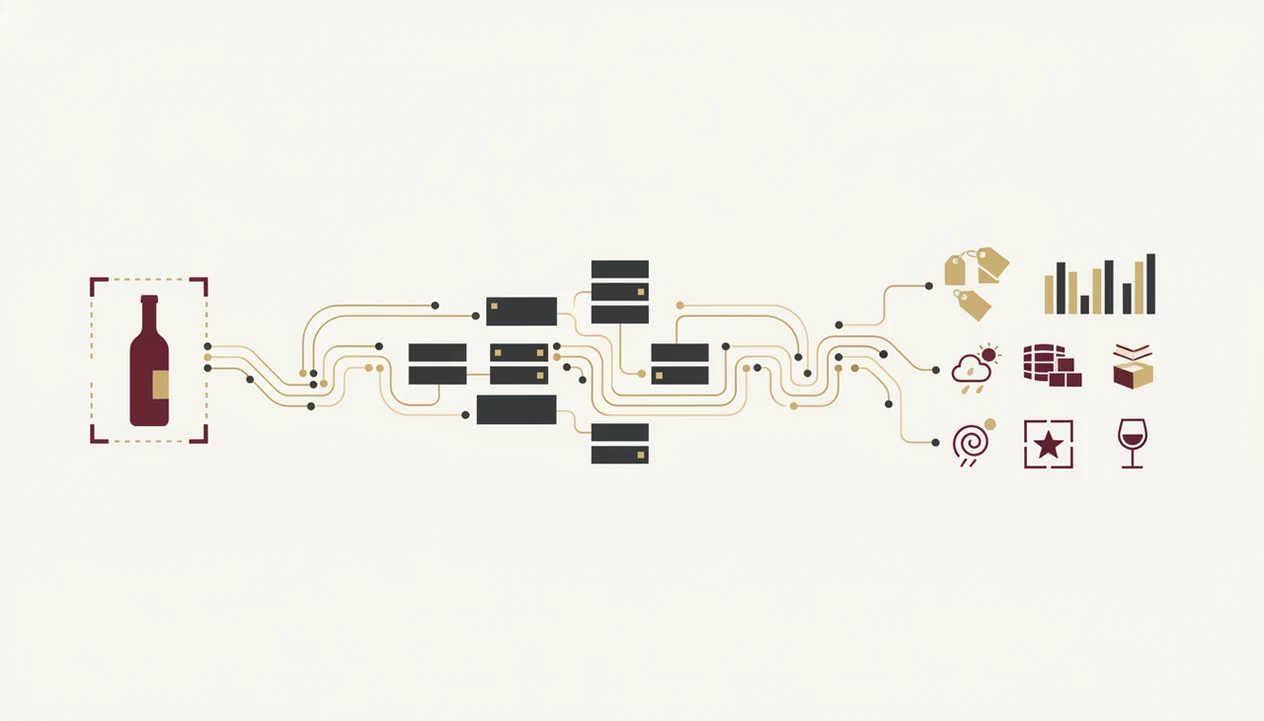
Wine valuation explained starts with matching, then moves into judgment. Price lookup is a technical task; value estimation is a layered reading of market data, wine quality, and bottle risk.
Price Lookup Data Flow
A price lookup usually matches producer, cuvée, vintage, bottle format, and sometimes region against retail databases, auction records, and merchant APIs. The cleaner the match, the better the comp. A 750 ml 2019 Rioja Reserva should not be compared casually with a magnum, a different vintage, or a Gran Reserva.
bridges that first gap through AI label recognition. It identifies the bottle first, then can surface price comps and related context. Good divino ai wine identification and sommelier app experiences deliver bottle recognition, price context, and pairing clues, not a pretend guarantee that every listing equals true value.
Value Estimation Judgment Layer
Value estimation layers the market range with critic scores, production volume, provenance chain, cellar conditions, and current demand curves. Restaurant and bar prices distort this layer because markups often run 200–300% over wholesale, with wine cost commonly targeted around 27–34% of menu price. A $96 bottle on a list may not be a $96 wine in the open market.
Turn the bottle around under a kitchen pendant light and find the tiny appellation line. That small line often explains more than the front label romance.
How to Check Wine Price and Assess Value with DiVino
Use price first, then value. That order keeps you from turning a quick scan into a vague impression.
- Scan the wine label or restaurant menu with DiVino AI camera to identify the producer, vintage, region, and format.
- Review the instant price range pulled from retail and auction comps, then note whether the listed price sits above or below the range.
- Check vintage details, critic ratings, and producer notes inside Wine Identifier App before assuming a low price is a bargain.
- Compare the listed price against the contextual data to judge whether it represents fair value for the occasion, not just the market.
- Log the bottle to your DiVino cellar so future price movement, tasting notes, and value shifts stay attached to the same wine.
If your priority is choosing confidently for dinner, Wine Identifier App earns its place because food pairing recommendations add an occasion-based value signal. Pair the sauce, not only the protein.
Restaurant Wine Pricing and Markup Distortions
Restaurant wine pricing often reflects service economics more than bottle value. A wine list price includes rent, glassware, staff, storage, breakage, taxes, and profit, not just the liquid in the bottle.
Bars and restaurants commonly mark wine up 200–300% over wholesale, and U.S. restaurant wine programs often target a wine cost percentage of about 27–34% of menu price, per US Foods guidance source. That is why the glass price can hover near the wholesale cost of the bottle.
Psychology adds another distortion. In a controlled wine-tasting study, researchers found that higher stated prices increased perceived pleasantness even when the wine itself was identical source. Ouch.
Diners checking a wine list before ordering shared appetizers benefit from Wine Identifier App because menu scanning helps compare restaurant pricing against market context and pairing fit. Public retail prices can also mislead for rare wines, where negotiated sales and private trades never appear in the obvious listings.
4 Common Myths About Wine Price and Wine Value
The biggest mistake is treating one number as the whole truth. Wine value is built from price, condition, reputation, and use.
- Myth 1: Online price equals true value. A listing tells you an asking price, not whether your bottle has good fill level, sound cork, or a clean provenance trail.
- Myth 2: Expensive wine always tastes better. Branding, scarcity, and reputation can inflate price without guaranteeing enjoyment. Cherry-skin bitterness in Sangiovese may delight one person and bother another.
- Myth 3: Auction estimates or app results are final. They are indicators, but they can miss heat damage, counterfeits, label damage, or a soft selling channel.
- Myth 4: Value is objective and universal. Taste, budget, timing, and food all change the answer.
For everyday buyers, wine value usually depends more on fit and condition than on the highest listed price. If the label is smudged after condensation has softened the paper, even identification needs a second look.
Buyer Scenarios for Wine Price Lookup vs Value Estimation
Choose price lookup when speed matters; choose value estimation when consequences matter. The ideal workflow is usually price lookup first, then value judgment.
| Buyer situation | Better starting point | Why |
|---|---|---|
| Casual buyer in a store | Price lookup | A quick range prevents obvious overpaying |
| Diner checking a wine list | Price lookup | Markup context helps, especially with unfamiliar producers |
| Seller listing one bottle | Price lookup | Recent comps set a practical baseline |
| Collector building a cellar | Value estimation | Provenance, vintage, and drinking window matter |
| Investor evaluating resale | Value estimation | Demand and rarity shape future worth |
| Enthusiast choosing between two bottles | Both | Price frames the choice; value explains the better fit |
Beginners who whisper, “Is Rioja the grape or the place?” often need the simplicity of lookup first. Experienced collectors need the value layer.
When the trigger moment is choosing between two similar bottles, Wine Identifier App supports both sides because one scan can start with price comps and continue into vintage notes, cellar logging, and pairing guidance. For deeper label-based workflows, the check wine value from label guide goes further.
Evidence Behind Wine Price Lookup and Wine Value Signals
The evidence behind wine price lookup is transactional, while the evidence behind wine value is contextual. A good comparison needs both, because a bottle can be easy to price and still hard to value.
Price-lookup data usually starts with retail listings, auction records, and merchant feeds. Those sources show what sellers are asking, what buyers have recently paid, and how widely the same bottle appears across channels. Value signals sit one layer deeper: critic scores, vintage reports, provenance, and storage documentation help explain whether a number is sensible for the bottle in front of you.
A practical reading order looks like this:
- Match the exact producer, cuvée, vintage, region, and bottle size before trusting any comp.
- Separate restaurant pricing from open-market resale pricing, because menu markups reflect service costs as much as wine demand.
- Compare asking prices with realized sale prices, especially at auction, where the gap can be sharp.
- Weigh the strongest signals for your use case: casual buyers should prioritize current retail range, drinking fit, and food pairing, while collectors should lean harder on provenance, storage records, rarity, and vintage reputation.
- Question any single number that ignores condition.
Limitations
Wine price lookup and wine value tools are useful shortcuts, not rules. They reduce uncertainty, but they do not remove it.
- Market prices move with vintage reputation updates, critic re-scores, economic cycles, and demand shifts. Today’s fair price can date quickly.
- No app or algorithm can fully assess ullage, seepage, cork condition, label damage, counterfeit risk, or improper storage.
- Public retail listings may not reflect realized sale prices, especially for rare wines sold through negotiated deals or off-platform trades.
- Psychological pricing bias means consumer satisfaction data and value surveys always carry some subjectivity.
- Niche, very rare, or poorly documented wines may have too few comps for reliable estimates. Wide uncertainty bands are normal.
- CellarTracker, Wine-Searcher, vivino.com, and cellartracker.com can all show useful signals, but their results may differ because their data pools differ.
- Food pairing value is contextual. Lemon-zest acidity with goat cheese may be excellent for one dinner and irrelevant for a resale decision.
Collectors who track auction bottles wrapped in tissue paper should use Wine Identifier App as one input, not the final authority, because condition still needs human inspection. For scanner reliability details, read are wine scanner apps accurate.
FAQ
Is wine price the same as value?
No. Wine price is a current market figure, while wine value is a contextual judgment based on quality, condition, rarity, provenance, and personal use.
Can an app accurately value wine?
An app can estimate a price range and surface value signals, but it cannot fully judge bottle-specific condition. Storage history, cork condition, ullage, and authenticity still need human review.
Why are restaurant wine prices so high?
Restaurant wine prices are often 200–300% above wholesale because the menu price covers service, storage, glassware, overhead, and profit. Many restaurants target wine cost at roughly 27–34% of the final menu price.
What factors increase a wine's value?
Vintage quality, producer reputation, rarity, critic scores, provenance, and documented storage can increase wine value. Demand in the current market also affects resale potential.
Does expensive wine always taste better?
No. Studies show that perceived quality can rise with price even when the wine is identical, so price can bias taste expectations.
What price range offers the best value?
For many everyday drinkers, the strongest value range is often about $8–$20 per bottle. Above that, quality can still improve, but the gain per extra dollar is less predictable.
How does a wine identifier app look up wine prices?
Wine Identifier App scans the label, identifies the producer, vintage, region, and format, then compares the bottle with retail and auction price comps. also adds vintage notes, cellar tracking, and pairing context.