How To Avoid Fake Wine Retailers After Scanning a Bottle


Download App: how to avoid fake wine retailers
To learn how to avoid fake wine retailers, use the bottle scan as a starting point: match the producer, vintage, region, and serial codes against the retailer's listing and the winery's official records before you buy. Then layer on website checks such as secure payment, a physical address, transparent returns, and independent reviews to filter out counterfeit sellers.
Fake wine retailers are online or physical sellers who list counterfeit, mislabeled, or grey-market bottles, often using cloned QR codes, copied product photos, and prices far below market to deceive buyers.
- Up to 20% of global wine trade may be counterfeit, so buy from authorized, verified retailers whenever possible.
- After scanning a label with DiVino, match producer, vintage, and serial codes to the retailer's product page and the winery's official data.
- Red flags include prices far below market, missing provenance details, pressure tactics, and hidden contact information.
- No single method is foolproof. Layer scan verification, website checks, and common-sense red-flag awareness together.
- Even reputable retailers can unknowingly receive fake stock, so provenance and chain-of-custody matter for every purchase.
What Fake Wine Retailers Actually Do
Fake wine retailers sell bottles whose identity cannot be trusted, either because the wine is counterfeit, mislabeled, diverted through grey-market channels, or presented with missing provenance. The safest first question is not “Does this look real?” but “Can this seller prove where it came from?”
Specialist estimates often put counterfeit wine as high as 20% of global trade, with annual value discussed around $65 billion. Use those figures as risk signals rather than precise consumer odds; published estimates vary by country, enforcement method, and whether grey-market bottles are counted. For context, see the OECD/EUIPO work on illicit trade and counterfeiting: https://www.oecd.org/gov/illicit-trade/. Those numbers vary by market, but the risk is real enough to change buying habits. Counterfeiters clone QR codes, reuse label data, copy product photos, and write vague listings that hide the wine’s path from producer to shelf.
It is not only grand cru Burgundy behind glass. Mid-range popular brands can be easier targets because they move quickly and draw less scrutiny. Grey-market wine is different from an outright fake. It may be genuine wine sold outside authorized channels, but storage, taxes, warranty, and provenance can still be unclear.
Turn the bottle around first.
How Wine Counterfeiting and Fake Retailer Schemes Work
Wine counterfeiting works by breaking trust at one or more points in the bottle’s identity chain: label, liquid, seller, shipment, or digital record. A convincing fake often combines a real-looking physical bottle with a copied online identity.
Fakes can enter distribution when stock is diverted, refilled, relabeled, or mixed into legitimate supply chains. Digital cloning adds another layer. A counterfeiter can copy QR codes, barcodes, producer text, and even tasting notes from a real bottle, then build a polished product page around that data. Some fake wine websites use stolen branding, invented reviews, hidden ownership, and checkout pages that vanish after payment.
The newer tools are better, but not casual. Chemical profiling and machine learning have reported near 100% accuracy in identifying estate origin in research settings. That is closer to lab authentication than ordinary shopping. For a buyer, a scan is a useful shortcut, not a rule. Scammers can replicate the digital layer too, which is why a scan result must be checked against the retailer, the winery, and the payment trail.
5 Facts About Fake Wine Websites Every Buyer Must Know
- Up to 20% of global wine trade is estimated by some specialists to involve counterfeit products, so provenance matters beyond luxury bottles.
- Economically motivated food fraud, including wine fraud, has been estimated to cost the global food industry billions of dollars annually; Michigan State University's Food Fraud Initiative summarizes the wider food-fraud risk here: https://www.canr.msu.edu/foodfraud/.
- AI chemical profiling has reported very high estate-of-origin accuracy in controlled wine-authentication research, but that is a lab setting, not a consumer checkout test; cite the specific study or replace this with a softer sourced claim before publication.
- Big marketplaces are not automatically safe wine retailers, because third-party sellers can list counterfeit or grey-market bottles.
- Convincing capsules, labels, and cartons can fool the naked eye; digital serial codes, smart tags, and winery records are better checks.
The practical lesson is simple: start with the label, then prove the seller. If a retailer lists a wax-sealed bottle on a marble counter but gives no vintage, lot, or storage details, the photo is decoration, not evidence. For buyers comparing scanner results, our guide on are wine scanner apps accurate explains what label recognition can and cannot confirm.
Red Flags That Expose Unsafe Wine Retailers
Unsafe wine retailers usually hide the boring details. Look for what is missing: address, phone number, business registration, tax number, return policy, invoice history, and the route the bottle took before it reached the seller.
Price is the loudest clue. A famous vintage offered far below market value should make you pause, especially if the page adds a countdown timer or “last case today” pressure. Poor photos are another warning, but so are overly polished images copied from a producer’s website. The listing should name the vintage, region, bottle size, alcohol level, and provenance for premium wine.
Payment terms matter. Avoid sellers that only accept crypto, wire transfer, Cash App, or other hard-to-reverse methods. A budget number circled in the margin of a restaurant list is normal. A rare bottle at half price with no phone number is not. When privacy is part of your checking process, the wine app privacy guide explains what data a scanner may handle.
How To Verify a Wine Retailer After Scanning with DiVino
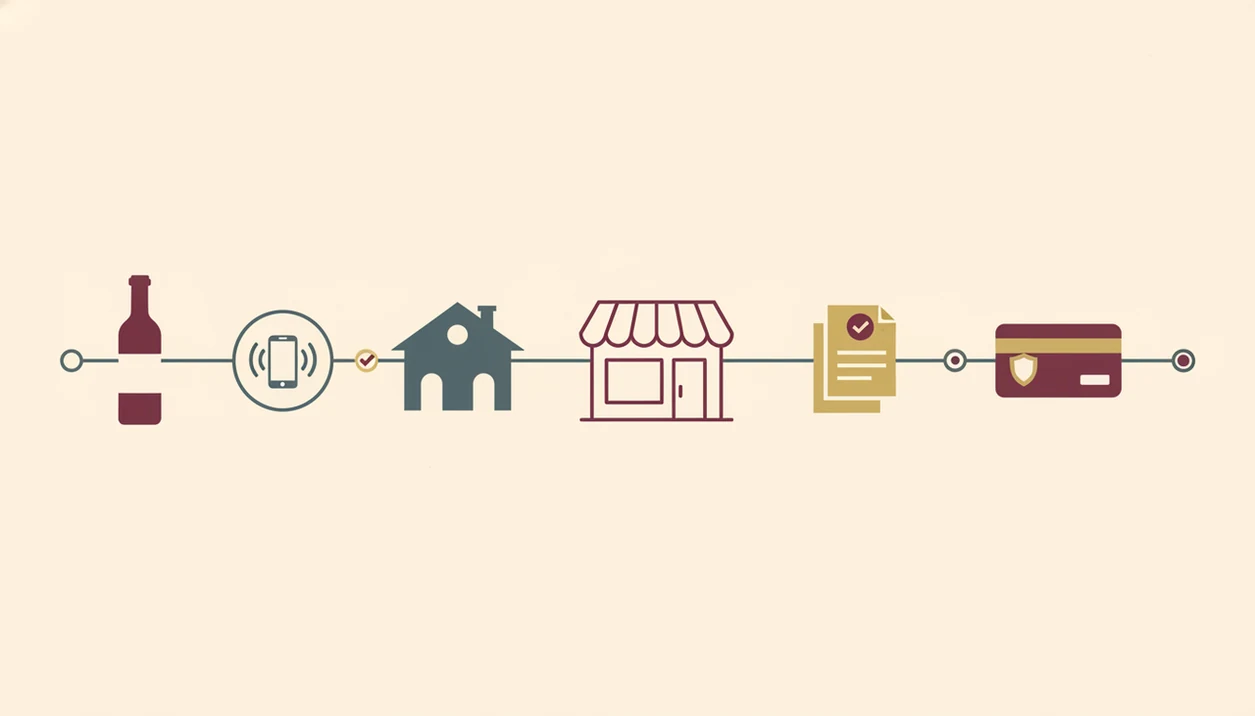
Use the scan as evidence to compare, not as a final verdict. No single step is enough, but layered checks reduce the chance of buying from fake wine websites.
- Scan the label or QR code with DiVino to capture the producer, vintage, region, appellation, barcode, and any unique codes.
- Compare the scan data against the retailer’s listing for an exact match in name, vintage, bottle size, region, and alcohol level.
- Cross-check key details with the winery’s official website, importer page, or published distributor information.
- Inspect the retailer’s website for https checkout, a physical address, phone number, clear shipping terms, and return policies.
- Search independent reviews outside the retailer’s own site, including complaint forums, marketplace feedback, and wine community posts.
I like to turn the bottle under a kitchen pendant light and find the tiny appellation line before trusting any listing. Good wine identification apps deliver producer, vintage, region, and pairing context, not a courtroom-grade authenticity certificate. If you upload label images while checking a seller, read is it safe to upload wine label photos before making it a habit.
Safe Wine Retailer Guarantees To Look For
Safe wine retailers make verification easy before they ask for payment. A legitimate seller should show a registered business name, physical address, licensing where required, phone or email support, and clear ownership.
Checkout should use https and mainstream payment providers that offer dispute paths. Shipping, returns, refunds, heat policies, breakage rules, and delivery restrictions should be written plainly. For premium or collectible bottles, ask for provenance documentation: purchase history, cellar conditions, invoices, importer details, and photographs of the exact bottle.
Smart packaging can help. Tamper-proof tags, holograms, serialized QR codes, and blockchain-backed records give buyers more to compare than a pretty label. Tools like Wine Identifier App can help organize the bottle details you see, but the retailer still has to prove the chain of custody. For a cellar bottle, an empty slot after a birthday bottle is memorable; for a purchase, paperwork is better.
Common Myths About Spotting Fake Wine Retailers
A successful scan does not prove the retailer is legitimate. It proves the code or label returned data, and scammers can clone that data from a real bottle.
Another myth is that major marketplaces are always safe wine retailers. The platform may be familiar, but the individual seller still matters. Third-party listings can bypass careful wine-specific vetting, especially when stock changes fast. Check the seller name, business details, reviews, and return terms, not just the marketplace logo.
Cheap wine is not immune. Counterfeiters often target mid-range, high-volume bottles because buyers inspect them less closely. The same applies to popular gift wines, restaurant-list names, and recognizable labels.
Visual inspection has limits too. Skilled forgers can make capsules, labels, cartons, and back labels look right. I have scanned a smudged back label after condensation softened the paper and still had to compare the vintage line with the producer’s site. Appearance helps, but records decide.
When To Contact the Winery, Payment Provider, or Authorities
Contact the winery, payment provider, marketplace, or authorities as soon as the seller’s story stops matching the bottle. Escalate faster when the bottle is rare, expensive, or meant for resale.
- Contact the winery when serial numbers, QR results, label details, importer marks, or provenance records conflict. Send clear photos of the front label, back label, capsule, bottle base, codes, receipt, and seller listing.
- Open a payment dispute quickly if the retailer disappears, refuses basic documentation, changes the listing after purchase, or pushes you toward a private refund outside the payment system.
- Report the listing inside the marketplace first, using its counterfeit, fraud, or prohibited-goods form before posting external reviews. Platforms can preserve seller data and may remove duplicate listings.
- Use local consumer protection offices, alcohol control boards, trading standards, or law enforcement when you suspect fraud, unsafe alcohol, tax evasion, or repeated fake listings.
- Seek professional authentication for rare, collectible, auction-bound, or high-value bottles. A specialist can inspect paper, glass, cork, fill level, capsule, storage history, and chain-of-custody records in ways a normal scan cannot.
Scope and Safety Disclaimer
This guide helps reduce the risk of buying from fake wine retailers, but it cannot prove a bottle is authentic on its own. A scan, website check, or matching product photo is a useful screening tool, not legal, financial, or laboratory authentication advice.
Alcohol laws, shipping rules, refund rights, import duties, and marketplace protections change by country, state, and local authority. If the purchase is expensive, collectible, auction-bound, or meant for resale, treat professional authentication as part of the cost, just like insured shipping or proper storage.
- Save screenshots of the product page, seller profile, checkout page, scan result, and any QR or serial-code response before the listing changes.
- Keep receipts, payment confirmations, shipping labels, and delivery notices in one folder so you can reconstruct the purchase trail.
- Preserve seller messages, refund promises, provenance claims, and photos of the exact bottle, including capsule, label, base, and codes.
- Ask a qualified wine authenticator, auction specialist, attorney, payment provider, or local alcohol authority when the value or legal risk is high.
- Avoid opening, reselling, or disposing of a disputed bottle until the relevant expert or platform tells you what evidence they need.
Limitations
Consumer-level wine authentication reduces risk; it does not eliminate it. Treat every result as one part of a larger check.
- QR and barcode scans are not foolproof because counterfeiters can clone codes and mimic digital landing pages.
- Many everyday wines lack blockchain tags, serialized closures, NFC chips, or other advanced anti-counterfeit features.
- Even reputable retailers can unknowingly receive fake stock from compromised supply chains or poorly documented brokers.
- AI and lab-based authentication can be highly accurate, but it is not yet affordable for routine consumer purchases.
- Combining label scanning, retailer due diligence, and red-flag checks lowers risk, but it cannot guarantee authenticity.
- Regional alcohol rules, import laws, and enforcement standards vary widely, so protection differs by market.
- A real bottle can still be badly stored, especially if grey-market handling left it in heat or light.
For most buyers, retailer verification is often safer than label inspection alone because provenance connects the bottle to a documented seller history.
Read more
FAQ
Can a QR code scan confirm authenticity?
A QR code scan can help verify bottle details, but it cannot confirm authenticity by itself because codes can be cloned. Match the scan result against the winery, retailer listing, and provenance records.
Are big marketplace wine sellers safe?
Big marketplaces are not automatically safe for wine purchases. Third-party sellers can still list counterfeit, grey-market, or poorly documented bottles.
Do counterfeiters fake cheap wines too?
Yes, counterfeiters also target mid-range and popular wines because volume is high and scrutiny is lower. Rare bottles are not the only risk.
What payment methods signal a scam?
Wire transfers, crypto, Cash App, and other hard-to-reverse payment methods are red flags. Safer retailers usually offer major cards or payment providers with dispute options.
How can a wine identifier app help spot fakes?
A wine identifier app can help by scanning the label and showing producer, vintage, region, and bottle details for cross-checking. It does not replace provenance documentation or retailer due diligence.
What is wine provenance documentation?
Wine provenance documentation is the chain-of-custody record showing where a bottle came from, who handled it, and how it was stored. It may include invoices, importer records, cellar notes, and auction history.
Should I trust wine reviews on-site?
On-site reviews can be fabricated or selectively displayed. Check independent reviews, complaint records, and wine community discussions outside the retailer’s website.
Where do I report a fake retailer?
Report a fake retailer to your local consumer protection agency, the marketplace or payment platform, and the winery whose bottle was misused. If you used DiVino, keep screenshots of the scan and listing for your records.