Tool That Can Recommend Wines I Like From My Ratings and Notes

A tool that can recommend wines I like learns your personal taste from bottle ratings, tasting notes, and scan history, then matches those patterns against wine databases to suggest bottles you are likely to enjoy. The more you rate bottles honestly, including the ones you would not buy again, the more useful the suggestions become.
A wine recommendation tool is an app or platform that builds a personal taste profile from your ratings, notes, and scanning history, then uses AI or collaborative filtering to suggest new wines aligned with your preferences.
- Rate wines with simple stars or short notes, the app learns your taste patterns automatically.
- AI matches your profile against thousands of bottles using flavor descriptors, regions, and grapes.
- DiVino adds label scanning and sommelier-style explanations so you understand why a wine fits.
What a Wine Preference App Does With Your Bottle Ratings
A wine preference app turns your ratings, notes, and bottle scans into a personal taste profile. It is different from a critic-score app because it asks, “What do you keep liking?” rather than “What did reviewers praise?”
Start with the label. A five-star rating on a Rioja, a two-star rating on a sweet Moscato, and a note that says “too oaky” are not throwaway details. They become signals. Over time, the app can notice that you prefer bright acidity, soft tannins, or ripe fruit, not just sweet fruit.
You do not need wine jargon for the app to learn. “Sharp with goat cheese” is useful. So is “smooth but boring.” I have watched people freeze at the counter after a first cork sniff, as if they need to say “terroir” correctly. They don't. Plain language is often cleaner data.
For beginners, a personal-taste tool is often more useful than a critic-score lookup because it learns from your own repeat choices.
5 Requirements Before You Start Rating Wines in an App
Before a wine preference app can recommend well, it needs a few simple inputs from you. The setup is lighter than most people expect.
- A smartphone with a camera: Label scanning helps capture producer, vintage, region, and grape without typing.
- Five to ten starter ratings: This gives the tool enough early shape to avoid generic suggestions.
- A simple star score: Use the same scale each time, even if your notes are casual.
- One-line tasting notes: “Cherry-skin bitterness,” “lemon-zest acidity,” or “too much vanilla” all help.
- A rough price range: Recommendations are more useful when the app knows whether Tuesday dinner means $15 or $45.
No sommelier training required. No performance.
I often tell new users to rate the bottle still on the table, before memory turns “fresh” into “nice.” That small timing habit matters more than knowing every grape synonym.
How Wine Recommendation Engines Use Ratings, Notes, and Similar Users
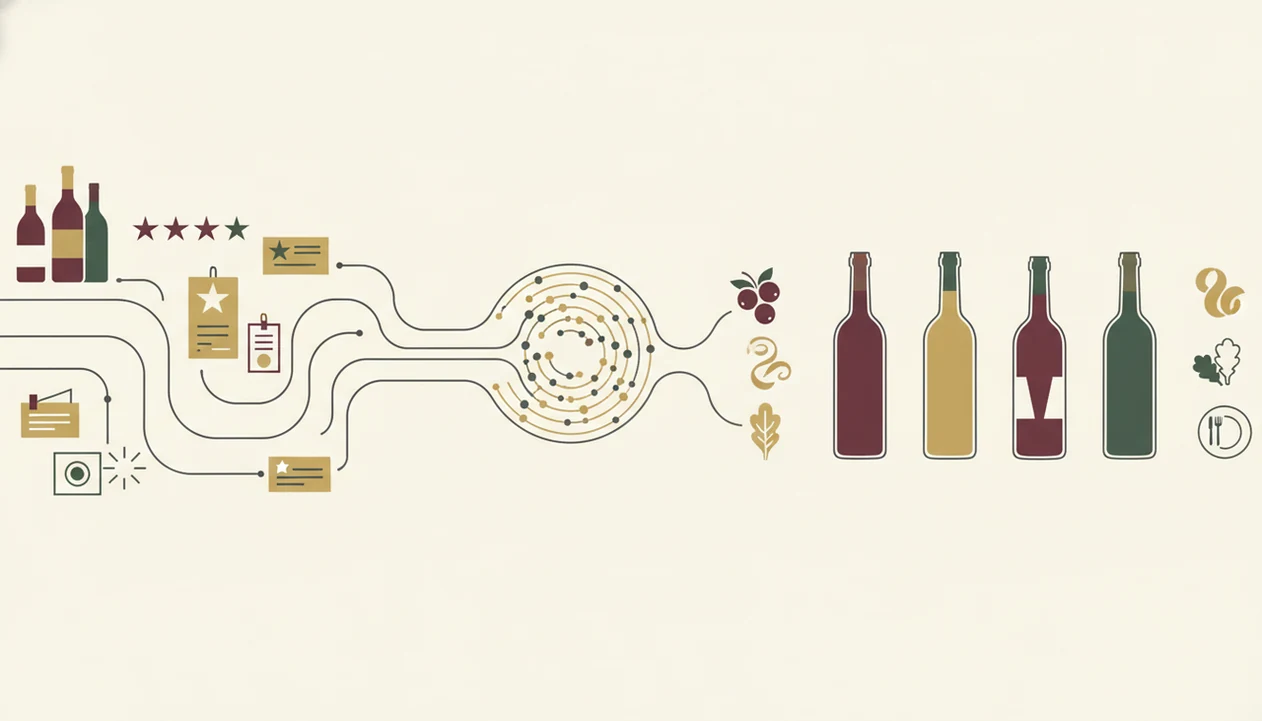
Wine recommendation engines work by combining your ratings with patterns from similar users, tasting-note language, and structured bottle data. In plain terms, the system looks for wines that sit near bottles you already liked.
- Collaborative filtering compares your ratings with people who rate bottles in similar ways.
- Natural language processing reads tasting notes and groups words like “citrus,” “buttery,” “earthy,” or “jammy.”
- Taste-space mapping treats wines as vectors, placing similar bottles close together in the model.
- Negative feedback matters because dislikes, skips, and low scores teach the system what to avoid.
- Machine learning models can predict wine quality scores from structured chemical and sensory data in benchmark wine datasets, which supports the broader idea that wine attributes can be modeled. For example, the UCI Wine Quality dataset is commonly used to model wine attributes against quality scores: https://archive.ics.uci.edu/dataset/186/wine+quality.
Collaborative Filtering and Taste-Profile Matching
Collaborative filtering is the same broad recommender idea used in many consumer apps. Research on recommender systems has shown that personalized filtering can improve satisfaction compared with non-personalized baselines. A widely cited overview of recommender-system methods and evaluation is Ricci, Rokach, and Shapira’s Recommender Systems Handbook: https://link.springer.com/book/10.1007/978-1-4899-7637-6. In wine, that means your three-star shrug at a heavy Cabernet may be as useful as your five-star note on a nervy Albariño.
Text Analysis of Tasting Notes and Flavor Descriptors
Text analysis gives the app more nuance than stars alone. If you write “pencil graphite scent in red wine,” the tool can place that closer to Cabernet, Bordeaux blends, or certain structured reds than to soft, fruit-forward styles.
Evidence Behind Wine Recommendation Accuracy
The evidence behind wine recommendation accuracy is strongest for the building blocks: personalized filtering, structured wine datasets, and repeated user feedback. It is weaker when a specific app claims a private match score without publishing its own validation.
- Treat ratings as the clearest signal: Collaborative filtering research supports the idea that users with similar rating patterns can improve personalized recommendations. In wine terms, your low score on a syrupy red can narrow the model as much as a high score on a lean white.
- Use notes as texture, not proof: Tasting-note language helps cluster “buttery,” “green apple,” or “earthy,” but those words are subjective and may vary by drinker.
- Read label scans as identity data: Scans improve accuracy by capturing producer, vintage, region, and grape, reducing typos and vague entries.
- Treat availability as a separate layer: Stock, country, shipping rules, and shop inventory affect whether a good match is actually buyable.
- Expect confidence to grow: More ratings give the model repeated examples, so it can separate a one-off mood from a stable preference.
Wine-quality and sensory benchmark datasets show that wine attributes can be modeled, but that evidence is indirect unless the app has tested its own recommendations with real users.
5 Steps to Use a Wine Recommendation Tool From Your Ratings
To use a wine recommendation tool well, scan, rate, write one honest note, then check how the app updates your profile. The method is simple, but consistency is what makes it accurate.
- Scan a wine label or menu with the app camera so the exact producer, vintage, and region are saved.
- Rate the wine with stars and add one short flavor note, such as “dry, lemony, good with goat cheese.”
- Review your taste profile to see which grapes, regions, styles, and price ranges appear most often.
- Browse personalized recommendations sorted by match score, style, food pairing, or availability.
- Log each new bottle after tasting so the model can adjust and stop repeating weak suggestions.
Tools like Wine Identifier App can combine this scan, rate, and recommend flow in one place. If you want a broader overview of the category, the AI wine recommendation app guide explains how these systems compare.
A practical wine app delivers better next-bottle decisions, not instant expertise.
How DiVino Explains Wine Recommendations Beyond Match Scores
DiVino is useful because it explains why a recommendation fits, not only that it scores highly. The app connects label recognition with sommelier-style guidance around grape, region, body, acidity, tannin, and flavor profile.
That “why” matters. If a recommendation says you may like a Chianti Classico because you often rate medium-bodied reds with cherry-skin bitterness and bright acidity, you learn something reusable. Next time, you can look for the region before the romance.
Most recommendation articles focus on the score. They skip the explanation. Apps such as Wine Identifier App, Vivino, CellarTracker, and Wine-Searcher take different paths here, but the useful distinction is transparency. A black-box number may help you buy once. A clear reason helps you shop better later.
For readers comparing digital guidance with restaurant service, the AI sommelier vs human sommelier discussion is the natural next layer.
6 Common Mistakes That Weaken Wine Recommendation Accuracy
Wine recommendation accuracy drops when the app receives thin, one-sided, or inconsistent feedback. The model can only learn from what you actually record.
- Rating too few wines: Three ratings usually produce broad guesses, not personal recommendations.
- Only rating wines you love: Dislikes teach the system which styles to filter out.
- Skipping the notes field: Stars say “how much,” but words explain “why.”
- Changing your scale: If four stars means “fine” one week and “excellent” the next, the profile blurs.
- Never exploring outside suggestions: The app can trap you in familiar grapes if you never test nearby styles.
- Expecting sommelier-level context: A tool cannot fully read the room, the sauce, or the guest who dislikes oak.
The server hovering with a corkscrew is still a different moment. An app can help you prepare, but it cannot ask follow-up questions at the table like a skilled person can. For restaurant-specific scanning, the best wine menu scanner app guide goes deeper.
3 Checks to Verify Your Wine Taste Profile Is Accurate
You can verify a wine taste profile by comparing its top suggestions with bottles you already know, checking the grape and region breakdown, and testing one new recommendation before buying several. Treat the profile as a draft, not a verdict.
- Check known favorites: If the app recommends wines near bottles you already enjoy, the model is probably reading you correctly.
- Audit grapes and regions: A profile that says you love buttery Chardonnay when you mostly rate Riesling highly needs more data.
- Test one bottle blind: Buy a single recommendation before committing to a case.
Large wine apps have reported tens of millions of users and large review databases, which gives popular bottles stronger prediction signals; Vivino, for example, describes its community and wine database here: https://www.vivino.com/about. The bottle universe is also economically large and fragmented, with market researchers sizing global wine revenue in the hundreds of billions of dollars: https://www.grandviewresearch.com/industry-analysis/wine-market.
A sticky note with a drinking window can still beat software if the bottle is rare and barely reviewed.
Limitations
Wine recommendation tools are useful shortcuts, not rules. They help translate patterns, but they cannot model every detail that changes what you are actually tasting.
- Low-data wines are harder: Obscure regions, tiny producers, and older vintages may produce weak or generic suggestions.
- Early ratings can overfit: If you begin with only plush reds, the app may keep you inside that lane too long.
- Context changes flavor: Food, serving temperature, glassware, mood, and company all affect perception.
- Stars alone are thin data: Accuracy drops when you rarely add notes or only rate once in a while.
- Availability varies: A recommended bottle may not be sold in your state, country, or local shop.
- Cellar advice has limits: Apps cannot fully replace in-person guidance on aging, storage, provenance, or auction risk.
- Pairing logic is imperfect: Pair the sauce, not only the protein, and check the actual dish.
Good divino ai wine identification and sommelier app experiences explain bottle fit and taste patterns, not guaranteed pleasure or expert certainty. If you are deciding whether the category earns its place on your phone, the is AI wine app worth it guide gives a practical cost-benefit view.
Read more
FAQ
Are wine recommendation apps free?
Most wine recommendation apps offer free tiers with label scanning, ratings, and basic recommendations. Premium versions may add cellar tools, deeper pairing advice, or advanced search filters.
Do I need wine knowledge to start?
No. Simple star ratings and notes like “too dry,” “fruity,” or “liked with pasta” are enough to build an early profile.
How many ratings before recommendations improve?
Recommendations usually become more useful after 10 to 20 honest ratings. They keep improving as you add both likes and dislikes.
Can a wine recommendation app suggest bottles for food pairings?
Yes, some tools include food pairing logic alongside taste matching. Wine Identifier App can connect a bottle recommendation to grape, region, body, and meal context.
Can I use a wine recommendation app on iPhone and Android?
Most mobile wine-label scanning and recommendation apps are built for iPhone and Android users. Check the current app store listing for device compatibility, region availability, and supported languages.
Will a wine recommendation app only suggest expensive wines?
No. Most recommendation tools work across everyday, mid-range, and premium price bands when you enter or filter by budget.
How does wine label scanning improve recommendations?
Label scanning captures exact producer, vintage, region, and sometimes grape data. That is more precise than typing “red blend” or guessing from memory.
Is my wine rating data private?
Reputable wine apps explain how ratings, scans, and notes are stored and used. Many anonymize user data when improving recommendation algorithms.