Wine Pairing Vs Wine Matching: Which Approach Builds Better Meals


Download App: wine pairing vs wine matching
Wine pairing vs wine matching comes down to scope: pairing is the broad concept of choosing a wine that complements a meal, while matching is the narrower, rule-based process of aligning a specific bottle to a specific dish's sauce, intensity, and flavor profile. supports both by scanning labels or menus, then turning dish details into practical bottle choices.
Definition: Wine pairing is the general practice of selecting wines that work well with food, while wine matching is a more precise, rule-driven recommendation that aligns a single wine to a dish's dominant flavor, sauce, and structural elements like acidity, tannin, and body.
TL;DR
- Pairing suggests a range of compatible wines; matching targets the single best bottle for a dish.
- Sauce, seasoning, and intensity matter more than protein type in both approaches.
- Complementary matches contrast flavors, congruent matches reinforce similar ones.
- AI tools like DiVino can apply matching logic at ingredient level for sharper recommendations.
- Personal preference is the final filter, no rule overrides what you actually enjoy.
At-a-Glance Comparison: Wine Pairing Vs Wine Matching
Wine pairing is broader and more flexible; wine matching is stricter and more exact. That difference matters because wine is not a small category: Grand View Research valued the global wine market at about $333.3 billion in 2023 (https://www.grandviewresearch.com/industry-analysis/wine-market).
| Dimension | Wine pairing | Wine matching |
|---|---|---|
| Definition | General food-and-wine compatibility | Specific bottle-to-dish alignment |
| Scope | Broad range of good options | Narrow recommendation for one dish |
| Precision level | Moderate | High |
| Decision inputs | Weight, flavor family, occasion | Sauce, seasoning, acidity, tannin, sweetness, body |
| Best for | Casual dinners, learning, mixed menus | Restaurant ordering, special meals, cellar decisions |
| Example output | “Try Pinot Noir, Gamay, or rosé” | “Choose the 2021 Rioja Crianza with tomato-braised lamb” |
I think of pairing as opening a map, while matching is dropping a pin. Wine Identifier App is useful when the steakhouse list opens to reds and the question becomes specific: not “red or white,” but “which bottle fits peppercorn sauce?”
Where Wine Pairing Wins Over Strict Matching Rules
Pairing wins when the meal has variety, the table has different tastes, or the person choosing wine is still learning. It gives safe lanes instead of one rigid answer, which lowers the pressure.
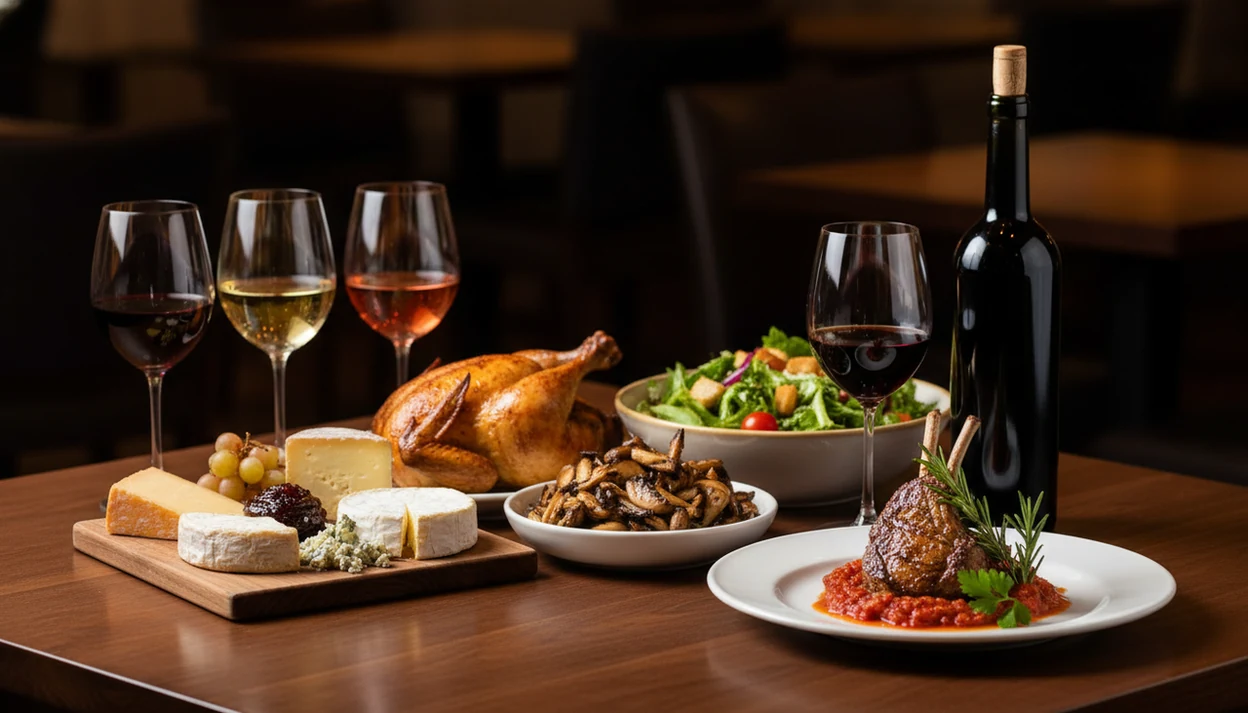
According to CDC alcohol-use data, about 25% of U.S. adults reported drinking wine in the past 30 days in 2023 (https://www.cdc.gov/nchs/nhis/index.htm). That is a broad audience, not a room full of sommeliers. For most beginners, pairing is the useful shortcut, not a rule. A holiday turkey carved beside stemware can handle Chardonnay, Pinot Noir, dry Riesling, or sparkling wine depending on the sides.
Complementary Pairing: Using Contrast for Balance
Complementary pairing uses contrast. Bright acidity can cut cream, sweetness can calm spice, and bubbles can refresh fried textures. Lemon-zest acidity with goat cheese is the clean example.
Congruent Pairing: Reinforcing Shared Flavors
Congruent pairing reinforces similar flavors. Earthy Pinot Noir with mushrooms or cherry-toned Sangiovese with tomato sauce works because the wine echoes the plate.
New hosts trying to serve three dishes at once usually need pairing, not strict matching, because Wine Identifier App can suggest several compatible styles instead of forcing one bottle.
Where Wine Matching Delivers More Precise Recommendations
Wine matching wins when one dish deserves a more exact answer. It works through decision layers: dominant flavor, sauce, intensity, structure, then preference.
- Dominant flavor comes first: A smoky chile sauce can matter more than chicken, beef, or tofu.
- Sauce-level detail beats protein shortcuts: Red-with-red-meat fails when the sauce is sweet, sharp, creamy, or very spicy.
- Structure controls the fit: Acidity, tannin, sweetness, and body decide whether the wine feels fresh or heavy.
- Personal preference still filters the result: Someone who dislikes oak may reject a technically sound match.
- Matching suits high-stakes choices: Restaurant ordering, collector bottles, and AI-driven recommendations benefit from narrower logic.
Sauce-Level Detail Beats Protein-Level Shortcuts
A tool to pair wine with steak should ask about char, fat, sauce, and seasoning, not only “steak.” The same ribeye changes with chimichurri, blue cheese, or soy glaze.
Structural Elements: Acidity, Tannin, Sweetness, Body
Young Nebbiolo can leave a chalky grip on the gums. That tannin needs fat, protein, or age, not a delicate lemon sole.
For diners who need one confident bottle from a long list, Wine Identifier App fits because menu scanning turns dish components into a single best-match recommendation.
How Wine Pairing and Matching Logic Actually Works
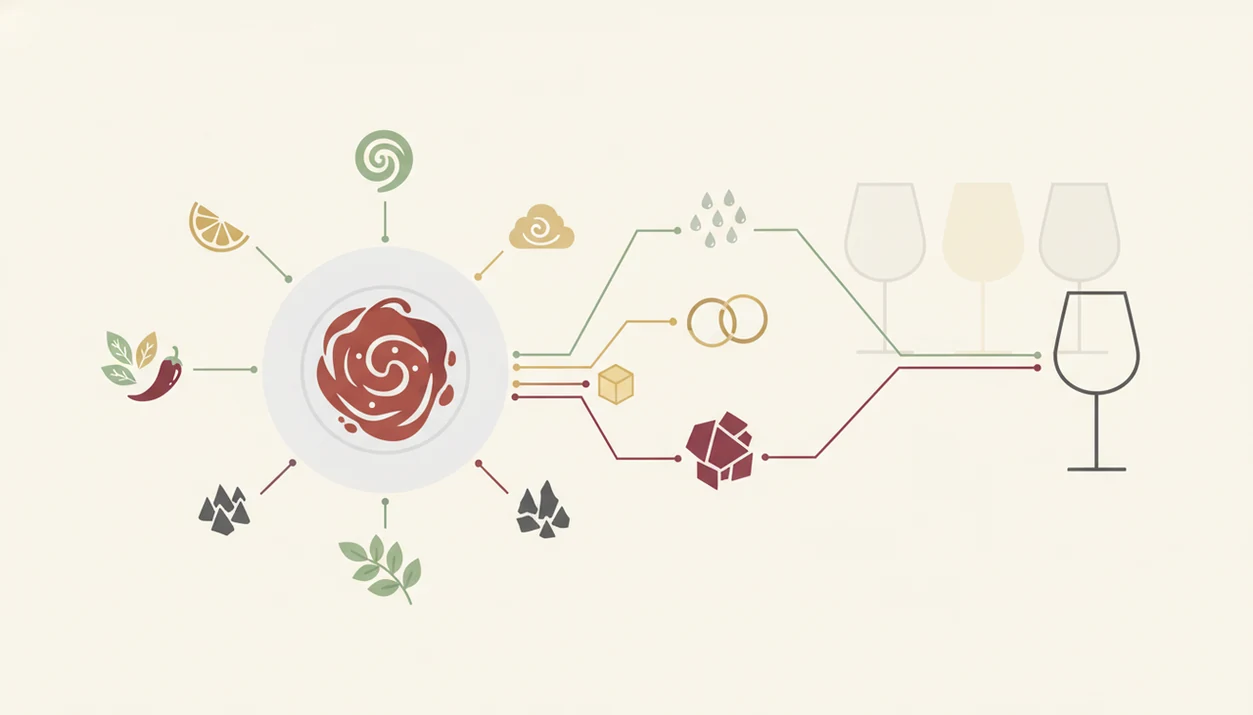
Pairing and matching work by moving from flavor to structure, then to personal preference. Pairing uses broad heuristics, such as light wine with light food; matching drills into the ingredients.
Decision Layers From Flavor to Preference
Start with the dominant flavor. Then assess sauce and seasoning, gauge intensity, check structural interaction, and apply preference. That order prevents the old protein trap. Pair the sauce, not only the protein.
Most published wine matching rules are expert heuristics, not controlled sensory-science laws. They are useful because they organize choices, but they don't prove that one bottle will please every person at the table.
How AI Moves From Pairing to Matching
AI wine tools use data flow: label scan, bottle profile, food input, recommendation. Image recognition can read a label, while dish parsing separates tomato, cream, spice, herbs, fat, and sweetness.
A good Wine Identifier App experience should deliver food-specific reasoning, not vague “goes with dinner” suggestions. Wine Identifier App handles this by connecting label recognition, menu scanning, and food input before recommending a bottle.
If the tiny vintage year above the barcode is hard to read, scanning still gives you a starting point. Then the dish details refine the match.
How to Use Pairing and Matching Rules at Your Next Meal
Use pairing first to find a good lane, then use matching when the dish has a clear sauce or centerpiece. The method is simple enough for Tuesday pasta and precise enough for a planned dinner.
- Identify the dominant flavor and sauce on the plate. Name the tomato, cream, chile, citrus, herb, smoke, or sweetness first.
- Gauge the dish intensity. Call it light, medium, or bold before choosing wine weight.
- Decide between contrast and reinforcement. Use complementary contrast for balance or congruent pairing for shared flavors.
- Check structural fit. Match acidity, tannin, sweetness, and body to the dish.
- Scan the label or menu with DiVino. Wine Identifier App can move from bottle profile to ingredient-level matching.
- Adjust for personal preference. Rules inform the choice; they don't dictate your glass.
Small pause. Taste first.
When the date-night table near the window gets quiet over a long wine list, an app that pairs wine with dinner can turn the decision into a few grounded options.
Pairing Concept Comparison: Pricing and Effort Differences
Broad pairing costs less effort because it needs fewer details. You can choose “crisp white with fresh seafood” or “soft red with roast chicken” without studying every ingredient.
Precise matching takes more work. It may require a sommelier, a detailed food-wine chart, or an AI app that can process dish components quickly. Pew Research Center reported that 42% of U.S. adults drink alcohol at least a few times a month, so most people need practical advice, not a seminar (https://www.pewresearch.org/short-reads/2024/06/14/most-americans-have-positive-views-of-alcohol-but-fewer-than-half-say-they-drink/).
Wine Identifier App reduces the effort gap because it scans labels and menus, then applies matching logic in seconds. For people comparing paid and no-cost tools, a free food wine pairing app can help with casual pairing, while more precise matching usually benefits from richer bottle and food data.
It is not laziness. It is dinner getting cold.
Who Should Pick Pairing and Who Should Pick Matching
Should you use wine pairing or wine matching? If your goal is exploration, pair; if your goal is precision, match.
Beginners, casual hosts, and tables with many dishes should usually start with pairing. It offers a range and keeps the meal relaxed. A cheese board, salad, roast vegetables, and grilled fish do not need one heroic bottle.
Restaurant diners, collectors, and people opening a special bottle should lean toward matching. Bottle neck tags swinging in cellar rows are a reminder that vintage, maturity, and style matter once money or rarity enters the decision.
Both approaches benefit from knowing the dominant flavor and sauce. Wine Identifier App supports both paths: browse pairing suggestions for flexibility or use a scanned menu for a single best-match recommendation. For a deeper tool comparison, the best wine pairing app guide explains what matters beyond simple food categories.
Collectors looking for dinner-ready bottles need matching because cellar choices depend on vintage, drinking window, and dish structure.
Common Wine Matching Rules That Mislead Beginners
Common wine matching rules are starting points, not laws. Beginners get better results when they treat them as questions to test.
- Red wine does not automatically belong with red meat. A tart, herbal sauce may make rosé or white wine work better.
- White wine is not always safer. Too much sweetness or soft acidity can clash with sharp, salty, or fatty dishes.
- Identical flavors are not always better. Contrast can outperform similarity, especially with rich or spicy food.
- Broad dish categories are too coarse. “Pasta” means little until you know tomato, cream, seafood, pesto, or ragù.
- Wine matching rules are heuristics. They summarize experience; they do not guarantee universal sensory agreement.
The awkward dinner-table whisper, “Is Rioja the grape or the place?” is exactly why rules need translation. For pasta specifically, a tool to pair wine with pasta should separate sauce from noodle shape.
For beginners, pairing is often easier than matching because it teaches flavor families before asking for bottle-level precision.
Evidence Behind Wine Pairing and Matching Rules
The evidence behind wine pairing is mixed: market and drinking-behavior data show why guidance is useful, while many exact “rules” remain expert shortcuts. Measured consumer behavior supports the need for simple recommendations, but preference testing can still overrule any rule-based match.
A practical evidence read looks like this:
- Separate heuristics from findings. “Pair the sauce” and “match intensity” are professional heuristics; market size, drinking frequency, and app-use patterns are measured behavior signals.
- Use consumer data as context. Large wine sales and regular alcohol-use surveys explain why beginners need quick, plain-language help rather than a cellar lecture.
- Keep structural variables in play. Sauce, acidity, tannin, sweetness, and body matter because they change texture, refreshment, bitterness, heat, and perceived weight in the glass.
- Read each platform by its strength. Vivino is strongest for crowd ratings and label recognition, CellarTracker for collector notes and cellar history, Wine-Searcher for pricing and availability, and Hello Vino for consumer-friendly pairing prompts.
- Taste against the rule. If the “correct” bottle tastes too oaky, too sweet, or too sharp to you, your palate wins.
That is the sober middle ground: use rules to choose faster, then let the table decide.
Limitations
Wine pairing and matching are helpful, but they leave plenty of room for real-life friction. No system sees the whole table.
- Individual taste can override any rule. If you dislike Sauvignon Blanc, goat cheese will not fix that.
- Simple rules like white-with-fish fail with spice, sweetness, smoke, or heavy sauces.
- Broad dish categories are too coarse for fusion menus and global flavors.
- Many published “golden rules” are expert heuristics, not replicated sensory-science findings.
- AI matching depends on the accuracy of the dish description, menu scan, or label scan.
- Regional availability limits precision. The recommended bottle may not be sold near you.
- Glassware, serving temperature, cellar age, and bottle condition can change the result.
- Competitors such as vivino.com, cellartracker.com, wine-searcher.com, delectable.com, and hello-vino.com may be stronger for price checking, cellar forums, or legacy reviews than for ingredient-level dinner matching.
Wine Identifier App works best when the input is specific: sauce, seasoning, bottle image, vintage, and preference. Scanning a smudged back label after condensation has softened the paper can still miss details, so a quick manual correction matters.
Read more
FAQ
Is wine matching better than pairing?
Wine matching is more precise than pairing, but it is not always better. Pairing is better for flexible meals, while matching is better for one specific dish.
Does sauce matter more than protein when choosing wine?
Yes, the dominant sauce or seasoning usually matters more than the base protein. A creamy, spicy, sweet, or acidic sauce can change the wine choice completely.
Can a wine pairing app replace a sommelier?
can handle matching logic, label scans, and menu scans. A sommelier still adds service judgment, cellar context, and the story behind a bottle.
What is a congruent wine pairing?
A congruent wine pairing matches wine and food with similar flavor traits. For example, an earthy red with mushrooms reinforces shared savory notes.
Does red wine always go with steak?
No, red wine does not always go with steak. Sauce, seasoning, preparation, and texture can make white wine or rosé a valid match.
How many wines can suit one dish?
Pairing usually produces several compatible wines for one dish. Matching aims to narrow those options to one best-fit bottle.
Should beginners follow wine matching rules?
Beginners should start with broad pairing guidance, then add matching rules as they learn. DiVino can help by showing the food logic behind each recommendation.