
Wine Shipping Rules Apps Should Explain Before You Hit Buy


Download App: wine shipping rules apps
Quick answer: wine shipping rules apps must clarify state-by-state legal restrictions, carrier requirements, and age-verification obligations before showing a purchase button because a bottle that looks available online may be illegal or impossible to deliver to your address. Apps that skip these checks waste users' time and can create compliance risk for retailers and shippers.
Definition: Wine shipping rules are the state laws, carrier agreements, licensing requirements, and delivery constraints that determine whether a specific bottle of wine can legally and practically be shipped from a retailer to a consumer's address.
This guide is for consumer education and product-evaluation purposes only; wineries, retailers, marketplaces, and fulfillment partners should confirm requirements with counsel, state alcohol regulators, and carrier contracts before shipping wine.
TL;DR
- 48 U.S. states allow some direct-to-consumer wine shipping, but restrictions vary wildly by destination state, volume caps, and shipper licensing.
- Major carriers like UPS require approved wine shipping agreements, so apps cannot treat all fulfillment paths as equal.
- A responsible wine app checks legal eligibility, carrier availability, and adult-signature requirements before surfacing a retailer option.
What Wine Shipping Rules Cover in Practice
Wine shipping rules cover four separate questions: where wine may be shipped, who may ship it, which carrier may carry it, and how the package must be delivered. A bottle can pass one check and fail another.
Start with the destination state. Some states allow winery-to-consumer shipping, some treat retailers differently, and some add permit or reporting duties. Then look at the shipper. A licensed retailer in New York does not automatically have permission to send wine into every other state.
Carrier rules are another layer. UPS says it will not accept wine shipments from shippers without an approved wine shipping agreement, according to its published wine policy source. That matters when an app shows a buy button beside a bottle.
The last mile is less glamorous but decisive. Adult signature, alcohol labels, packaging rules, and volume caps can still stop a shipment after the wine looks available.
The delivery door is part of the rule.
Five Facts About Wine Shipping Limits Every App User Should Know
- Most states allow some DTC wine shipping, not all. In the U.S., 48 states and D.C. allow some form of direct-to-consumer wine shipping, while Mississippi and Utah prohibit it in a cited industry summary; Delaware and Rhode Island are heavily restricted source.
- A case has a standard legal meaning. One wine case equals 9 liters, or 12 standard 750 mL bottles, according to Wine Spectator's state-by-state shipping reference. source
- Carrier acceptance is not automatic. UPS will not take wine from shippers that lack an approved agreement. A neat shipping label is not enough.
- Limits go beyond age checks. State laws may include annual volume caps, tax reporting, permit registration, and license-type restrictions.
- Legal eligibility and delivery execution are separate. A retailer may be allowed to sell into a state, but the package can still fail because of carrier rules, dry-area restrictions, or adult-signature problems.
For shoppers, destination-state checks are often more useful than generic “ships to U.S.” language because alcohol delivery rules depend on the address, not the bottle alone.
How Wine Shipping Compliance Works Behind the Scenes
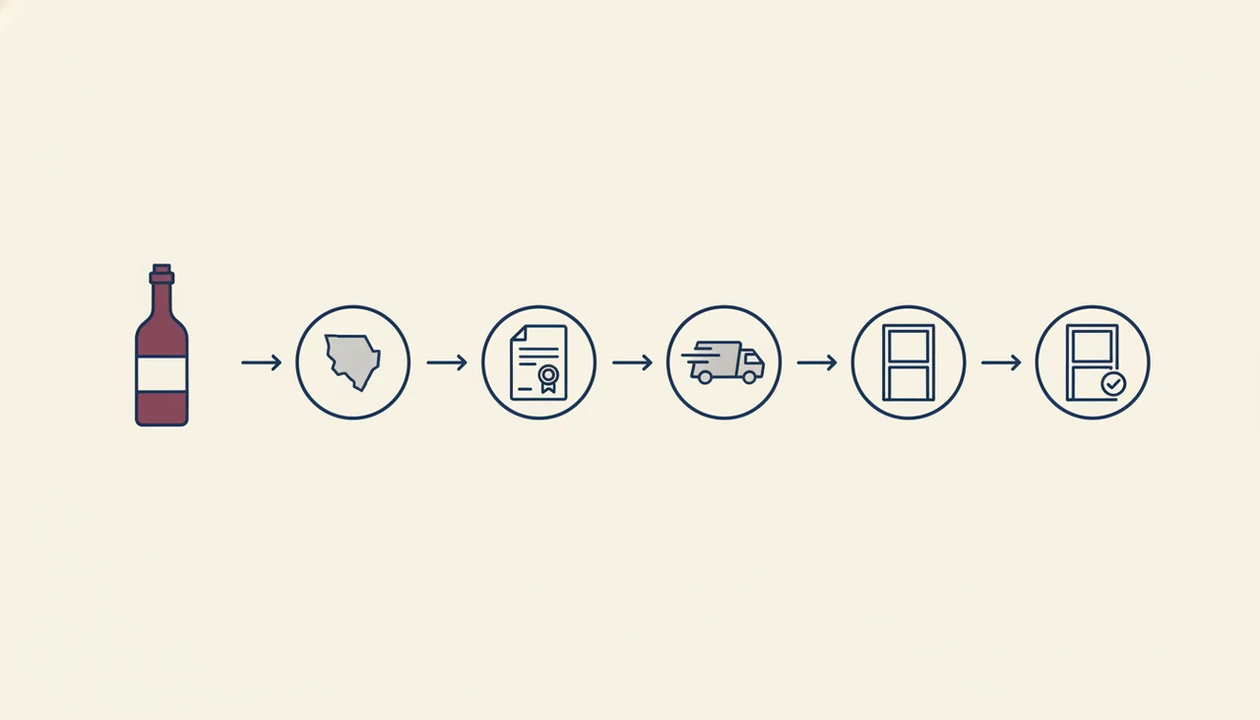
Wine shipping compliance usually works as a three-layer check: legal eligibility, shipper licensing, and carrier acceptance. In plain language, the system asks whether the law permits the shipment, whether the seller has the right permission, and whether a carrier will actually move the box.
Compliance tools often draw from state law databases, license tables, address validation, and carrier-program data. A checkout system may call a compliance API, then compare the destination ZIP code against restricted counties or dry areas. It is less romantic than turning a bottle around under a kitchen pendant light to find the tiny appellation line, but it matters just as much.
Legal Eligibility vs. Delivery Execution
Legal eligibility asks, “Can this type of seller send this wine to this state?” Delivery execution asks, “Can this carrier deliver this package to this exact address under alcohol rules?”
Carrier Agreements and Approved Shipping Solutions
Carrier contract verification checks whether the shipper is enrolled in approved alcohol programs, such as UPS Compatible Shipping solutions or FedEx alcohol programs. FedEx also requires alcohol shippers to enter an alcohol shipping agreement and follow its service rules source. Apps that compare bottle prices without this layer can show attractive dead ends.
Why Alcohol Delivery Rules Vary So Sharply by State
Alcohol delivery rules vary because U.S. alcohol regulation grew into a state-by-state system after Prohibition. There is no single national checkout rule for wine delivery.
That patchwork shows up quickly. Mississippi and Utah prohibit direct-to-consumer wine shipping in many summaries. Delaware and Rhode Island have severe restrictions. Other states allow shipping, but only under volume limits, permit rules, tax reporting, or winery-specific permissions.
Retailers face a different puzzle from wineries. A winery may be licensed to ship a case to one destination, while an out-of-state retailer offering the same bottle cannot use the same path. That is why the by-the-glass column on a chalkboard feels simple compared with online wine delivery.
A retailer shipping wine successfully into Oregon cannot assume the same checkout flow works for New Jersey, Arkansas, or Alabama. The rule follows the destination and the shipper type together.
Common Myths About Wine Shipping Rules Apps Repeat
The first myth is that “available” means deliverable. It does not. An app may find inventory at a retailer, but delivery still depends on the destination state, the seller’s license, and the carrier program.
The second myth is that any carrier can ship wine if the package label looks right. Major carriers require alcohol agreements, approved shipping systems, and special handling rules. The label is only one visible piece.
The third myth is that shipping limits are only about age verification. Adult signature matters, and wine app age verification deserves its own scrutiny, but states may also impose volume caps, license limits, and reporting duties.
The fourth myth is that one checkout flow works nationwide. It does not. A seafood menu beside chilled white wine may make the pairing decision feel easy; the shipping decision is a different map.
For wine buyers, “available online” usually means “listed somewhere,” while “shippable to me” means the bottle passed legal, license, carrier, and address checks.
What DiVino's Wine Identification Means for Shipping Transparency
Label scanning can identify the exact wine, vintage, producer, region, and sometimes importer. That detail gives a shipping system better context than a vague search for “red Burgundy” or “Napa Cabernet.”
Tools like Wine Identifier App can connect bottle recognition to purchase context, but they should suppress retailer options that are likely to fail before checkout. Nobody wants to scan a tiny vintage year above the barcode, tap “buy,” and then discover the destination is blocked.
Good divino ai wine identification and sommelier app features deliver bottle identity, style context, pairing guidance, and realistic next steps, not a promise that every recognized wine can be shipped to every address.
Wine Identifier App works as an identifier and sommelier aid, not as a licensed shipper. That distinction matters. The app can help interpret the bottle and surface more realistic purchase context, but the retailer and carrier still own fulfillment compliance.
Specific Guarantees Apps Should Make About Wine Shipping Rules
A trustworthy wine app should make specific guarantees about what it checks before showing a retailer. “We found this bottle” is not enough.
First, it should disclose destination-state restrictions before checkout. Second, it should show carrier requirements, including adult-signature obligations and whether alcohol shipment programs are involved. Third, it should state how often its compliance tables are updated. “Recently updated” is too soft.
Fourth, the app should clearly label volume limits and retailer licensing status when that information is known. If it is not known, say so.
These promises are not only legal hygiene. They also improve the user experience. If you are comparing bottles after scanning a smudged back label where condensation has softened the paper, the useful answer is not just the grape. It is whether the bottle can realistically reach your address.
For app users, a clear “not available for your destination” message is often better than a buy link that fails after payment details are entered.
What Wine Shipping Rules Apps Do Not Cover
Wine shipping rules apps do not replace legal counsel for retailers, wineries, marketplaces, or fulfillment partners. Licensing is specific, and small differences matter.
An app also may not verify a retailer’s exact permit type in real time. It might know that a state allows certain shipments, but not whether that retailer’s license covers that bottle, warehouse, or fulfillment route.
International shipping is a separate problem. Customs, duties, alcohol import laws, bottle labeling, and courier rules vary by country. A domestic U.S. wine shipping check should not be treated as a global permission slip.
Local rules can also be missed. Dry counties, restricted ZIP codes, and municipal ordinances may not appear cleanly in state-level databases. The same caution applies to privacy and location features; if an app uses your address to check delivery, the broader wine app privacy policy should explain how that location data is handled.
Short version: apps can reduce bad options, but they cannot certify every legal fact behind a shipment.
When to Consult a Wine Shipping Compliance Professional
Consult a wine shipping compliance professional whenever a shipping decision could affect licensing, payment acceptance, marketplace liability, or cross-state fulfillment. App guidance is useful screening, not final legal authorization.
A retailer or marketplace should be especially cautious before taking money for alcohol delivery across state lines. The hard cases are not always obvious from the bottle page: a warehouse in one state, a seller in another, a destination near a dry area, or a third-party fulfillment partner can change the answer.
Use this escalation path before treating a shipment as ready:
- Ask alcohol counsel to review cross-state sales if you operate as a retailer, marketplace, or multi-seller platform.
- Check the destination state’s alcohol regulator when the license type, permit duty, or consumer-shipping rule is unclear.
- Verify carrier agreements before accepting payment, printing labels, or promising delivery dates.
- Escalate unusual routes involving dry counties, restricted ZIP codes, fulfillment partners, or third-party sellers.
- Treat the app result as an early filter, then document the legal, license, carrier, and address checks that support the shipment.
That extra step can feel slow, but it is cheaper than unwinding a paid order that should never have shipped.
Limitations
Wine shipping compliance data is useful, but it is not final legal advice. The rules change, and the messy parts often sit outside the bottle database.
- Wine shipping rules apps do not replace legal advice; compliance depends on changing state law, shipper permits, retailer structure, and carrier contracts.
- A compliance check can be incomplete if it lacks the retailer’s license type, warehouse location, marketplace role, or fulfillment setup.
- Carrier acceptance does not guarantee delivery success. Adult signature, packaging, alcohol labels, and failed delivery attempts can still block the shipment.
- Many public summaries of state shipping rules become outdated, so apps built on stale tables can mislead shoppers.
- AI wine recommendation features are overhyped if they imply deliverability without verifying shipping eligibility.
- Address validation can miss local dry-area rules or building-level delivery restrictions.
- A wine app may identify the correct bottle and still have no reliable retailer path for your state.
- If label photos, addresses, or cellar records are used in the process, readers should also ask is it safe to upload wine label photos.
A recommendation can be smart and still be undeliverable.
FAQ
Which states prohibit wine shipping?
Mississippi and Utah are commonly cited as prohibiting direct-to-consumer wine shipping. Delaware and Rhode Island are often described as severely restricted rather than broadly open.
Can any carrier ship wine?
No. Major carriers require specific alcohol shipping agreements, approved programs, and shipment rules before they will accept wine.
What is the wine shipping case limit?
One case of wine equals 12 standard 750 mL bottles, or 9 liters. Many states set shipment or annual volume caps based on cases or liters.
Is adult signature required for wine delivery?
Yes, most alcohol shipments require an adult signature at delivery. A package may fail if no eligible adult is present.
Do wine apps check shipping legality?
Not all wine apps check destination-state shipping rules before showing purchase options. Some identify inventory or prices without verifying whether delivery is legal.
Can I ship wine to a friend?
Personal wine shipments usually face the same state laws and carrier rules as commercial shipments. Many carriers do not accept casual alcohol shipments from unapproved individuals.
How often do wine shipping laws change?
State legislatures and alcohol regulators update shipping rules regularly. Apps using old compliance tables can show options that no longer work.
Do wine identifier apps verify wine shipping eligibility?
Some wine identifier apps can connect bottle recognition to shipping context, but they should not be treated as licensed shippers or legal compliance systems. Its value is connecting bottle recognition to more realistic purchase context when shipping data is available.