
Wine App Age Verification for Buying, Referrals, and Delivery


Download App: wine app age verification
Wine app age verification is the multi-step process a wine app uses to confirm a user meets the legal drinking age before enabling alcohol purchases, retailer referrals, or delivery. In the U.S., that usually means date-of-birth collection, ID checks, approved verification services, and adult-signature delivery.
Definition: Wine app age verification is the set of identity and age-confirmation controls a wine application must enforce before allowing users to buy, ship, or receive alcohol through the app.
Scope note: This guide is general compliance and safety information, not legal advice. Alcohol-sale, shipping, and age-verification rules vary by jurisdiction, so retailers, shippers, and app operators should confirm requirements with qualified counsel or the relevant alcohol-control authority.
- U.S. law requires anyone buying or receiving alcohol through an app to be verified as 21 or older. A simple checkbox is not enough.
- Best practice layers multiple verification steps: age affirmation, date-of-birth entry, third-party ID verification, and adult-signature delivery.
- Wine apps can keep label scanning and sommelier features broadly accessible while gating commerce features behind stricter wine purchase verification.
What Wine App Age Verification Covers
Wine app age verification covers any app flow that helps a user buy, ship, or receive alcohol. It applies before in-app checkout, retailer referral checkout, shipment release, and doorstep handoff.
In the United States, the legal baseline is 21. The federal National Minimum Drinking Age Act of 1984 tied federal highway funds to a 21 minimum purchase or public-possession age, and CDC summarizes the policy as a legal drinking age of 21 across all states and D.C. (https://www.cdc.gov/alcohol/policy/minimum-legal-drinking-age/index.html). That matters even when the screen looks harmless, like a bottle page with a “buy nearby” button under the tasting notes.
A wine education feature is different. You might scan two similar bottles side by side to learn why one says Rioja and the other says Tempranillo. That is content. But if the next tap sends you to purchase, ship, or reserve alcohol, the app needs stronger age controls. Tools like Wine Identifier App can keep label scanning, cellar notes, and pairing guidance separate from commerce gates.
Why Alcohol App Age Checks Matter for Public Safety
Alcohol app age checks matter because online convenience can weaken the old in-person barrier at the shop counter. The public-safety stakes are not abstract; they show up in underage access, delivery mistakes, and seller liability.
- Excessive alcohol use was responsible for more than 178,000 deaths per year in the U.S. during 2020–2021, according to CDC estimates (https://www.cdc.gov/alcohol/features/excessive-alcohol-deaths.html).
- Underage drinkers ages 12–20 consumed about 11% of all alcohol in the United States, according to NIAAA (https://www.niaaa.nih.gov/publications/brochures-and-fact-sheets/underage-drinking).
- In CDC's 2023 Youth Risk Behavior Survey, 22% of high school students reported current alcohol use (https://www.cdc.gov/yrbs/).
- Legal responsibility usually sits with the licensed seller or shipper, not only the driver who rings the bell.
- Emerging laws, including the Texas App Store Accountability Act, are expanding age-verification duties for app developers and marketplaces.
The awkward part is design. A grocery aisle bottle tilted toward a phone is just a scan. A checkout button changes the legal posture.
How Wine Purchase Verification Works Behind the Scenes
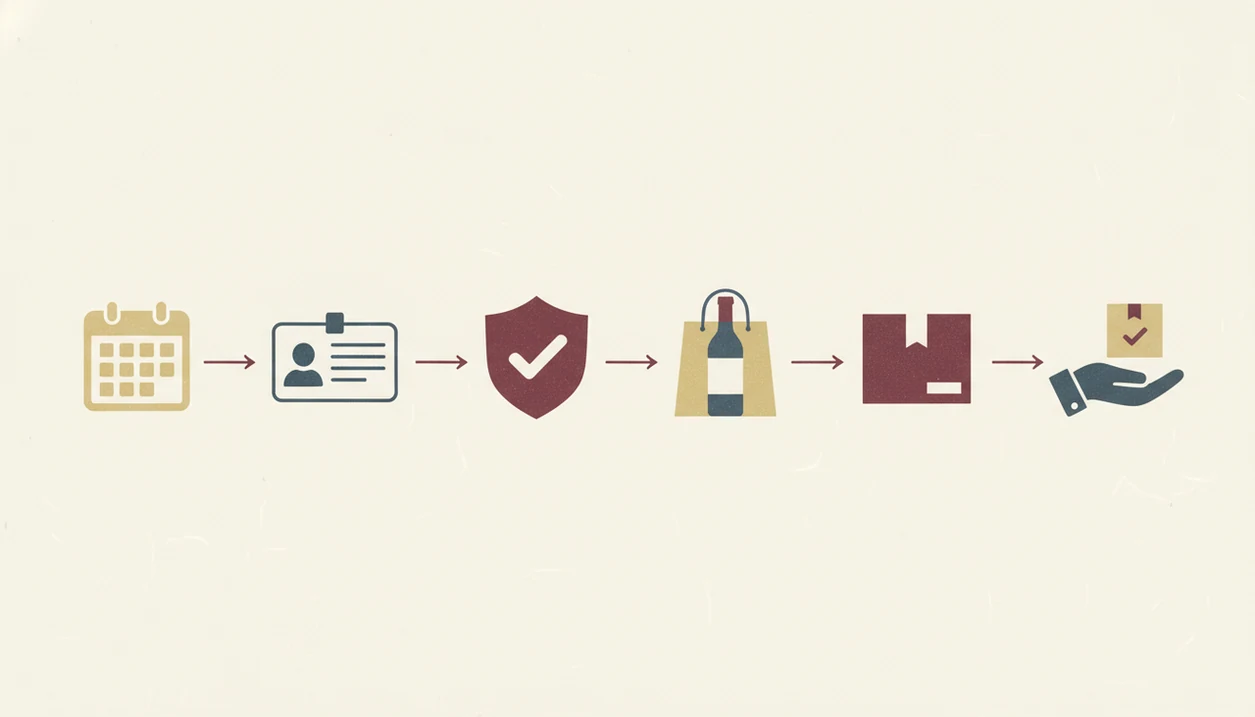
Wine purchase verification works by layering checks at the account, checkout, verification-service, and delivery stages. The goal is to reduce false claims without collecting more personal data than the law requires.
In-App Verification Layers
First, the app may show an age affirmation gate. That is the “I am 21 or older” step, but it should not stand alone. Second, the app collects date of birth and stores it securely. Third, checkout may trigger a state-approved or third-party online age verification service. These services can cross-reference submitted identity details against government ID databases or trusted records.
Jurisdiction logic sits underneath this flow. The rules for a California wine club shipment are not the same as rules for a restricted state or another country. For app teams, the most common way to reduce compliance gaps is to treat alcohol checkout as a separate permission layer from general wine education.
Delivery-Level Adult Signature Checks
Adult-signature delivery is the final control. The carrier confirms that an adult recipient is present and checks identification before releasing the package.
Phone-first wine intelligence should deliver bottle details, pairing context, and cellar organization, not a shortcut around alcohol law. separates content features like label scan and pairing from commerce features like buy or ship, so verification applies where required.
Specific Age Verification Guarantees DiVino Upholds
DiVino gates alcohol-commerce features behind multi-step wine app age verification before any purchase, shipment, or retailer referral flow is enabled. Educational wine tools stay separate from alcohol transaction tools.
- Commerce gating: Purchase, shipment, and referral paths require age checks before the user can continue.
- Open education tools: Wine identification, cellar tracking, food pairing, and tasting notes can remain available without commerce-level verification.
- Approved verification providers: Where direct-to-consumer shipping laws require it, state-approved verification services are used.
- Minimal data handling: ID data is retained only as long as legally required, then removed or de-identified according to policy.
- Adult-signature delivery: Alcohol shipments require adult verification at handoff, not just in the app.
That balance matters when someone scans a smudged back label after condensation has softened the paper. The scan can explain the bottle. Buying it requires a stricter gate. For related privacy handling, the wine app privacy guide explains the data side in more detail.
What Wine App Age Verification Does Not Cover
Wine app age verification cannot guarantee that every user is who they claim to be. Stolen IDs, parent accounts, shared devices, and VPNs can all weaken digital checks.
It also does not replace the delivery handoff. A shipment should still require an adult signature and ID review at the door. Verification is a chain, not one screen.
Not legal advice.
Age checks also do not turn educational content into commerce. A tasting wheel beside a notepad, a label scan, or a pairing suggestion is not the same as selling alcohol. That distinction helps apps keep learning features accessible while treating checkout with more care. Retailers and shippers should still consult counsel, especially when operating across state lines; wine shipping rules apps vary more than most users expect.
Common Misconceptions About Alcohol App Age Checks
“Is a single ‘I am over 21’ checkbox legally sufficient?” No. A checkbox can be one early signal, but alcohol-commerce flows usually need stronger verification.
One common myth is that delivery drivers carry all responsibility. In practice, the licensed seller or shipper often bears the legal duty to prevent underage sales, even when a carrier performs the final ID check.
Another myth is that age-verification laws only apply to social media or adult content apps. New app-account laws and alcohol-commerce rules can both affect wine apps.
A quieter mistake is collecting too much ID data. Scanning every user’s license may feel safer, but it creates privacy, security, and retention risk. If all someone wants is to compare cherry-skin bitterness in Sangiovese with softer Merlot tannins, commerce-level ID storage may be unnecessary. Related photo handling is covered in is it safe to upload wine label photos.
When to Contact a Professional About Age Verification
Contact a professional when the issue moves beyond a simple app prompt: legal exposure, a disputed delivery handoff, a locked account, a privacy request, or immediate safety risk. Age verification is partly software, but alcohol compliance also touches licensed sellers, carriers, lawyers, and health resources.
- Consult a licensed alcohol attorney before launching purchase, shipment, retailer-referral, or marketplace flows across multiple states. State rules can differ on who may sell, where wine may ship, which verification providers qualify, and what records must be kept.
- Contact the retailer or shipper if a carrier refuses delivery, asks for ID in a way that conflicts with the order terms, or releases no package after a failed adult-signature attempt. Keep the tracking number and notice.
- Use app support for failed identity checks, repeated verification loops, account locks, suspected misuse, or requests to access, correct, delete, or limit personal data.
- Reach a public-health, medical, or crisis resource right away if alcohol use creates immediate danger, impaired driving risk, threats, withdrawal symptoms, or concern for someone’s safety.
How to Contact DiVino About Age Verification or Privacy
Use the in-app support channel for age-verification problems, failed checks, or account-level questions. Include the transaction date, retailer name if applicable, and the shipment or referral reference.
For deletion, correction, or privacy requests, use the email address or contact form listed in the app privacy settings. Do not send a full ID image through ordinary email unless support specifically asks for a secure upload path.
If delivery verification fails or is disputed, contact support and the retailer or shipper tied to the order. Response times depend on the issue, but account and privacy requests should receive an acknowledgment within a reasonable support window. Keep the failed-delivery notice. It saves time.
Limitations
Wine app age verification reduces risk, but it does not remove every risk. The limits are real, and they affect users, retailers, carriers, and app teams.
- No digital age verification is foolproof; motivated minors can use stolen IDs, parent accounts, or shared devices.
- Third-party verification services add cost, latency, and integration complexity to checkout.
- ID collection and storage introduce security, privacy, and regulatory risk.
- Age-verification laws vary by state and country, so no single workflow covers every jurisdiction.
- Emerging laws such as the Texas ASAA may face legal challenges or change after implementation.
- Verification friction can increase cart abandonment, especially when users are comparing bottles quickly on a phone.
- Adult-signature delivery can still fail if the recipient is absent or the carrier cannot confirm ID.
Clinicians and public-health authorities generally support legal-age controls because underage alcohol access is tied to measurable harm. For users, multi-step verification is often safer than a checkbox because it checks age before checkout and again at delivery.
FAQ
Is a checkbox enough for age verification?
No. A single self-declaration checkbox does not meet most alcohol-commerce age-verification expectations.
Who is legally responsible for age checks?
The licensed seller or shipper usually bears responsibility for preventing underage alcohol sales. Delivery drivers perform an important final check, but they are not the only responsible party.
How is ID data stored after age verification?
ID data should be retained only as long as legally required or needed to complete verification, then deleted or de-identified according to policy. ID data is kept only as long as legally required or needed to complete verification.
Can minors use wine identification features?
Non-commerce wine identification and education features can be treated differently from alcohol purchase features. Commerce flows require age verification.
What happens if delivery verification fails?
If an adult signature cannot be obtained, the carrier should not release the alcohol shipment. The order may be returned, rescheduled, or handled under the retailer’s policy.
Do wine app age rules vary by state?
Yes. Direct-to-consumer wine shipping and verification rules differ across U.S. states and countries.
How do third-party verification services work?
Third-party services compare submitted identity details with government ID records or trusted databases. Some states require approved providers for online alcohol purchases.
Does age verification apply to referral links?
Yes. Retailer referral links that lead to alcohol purchase generally require age verification at checkout.